Date:
21.11.2026
Reading time:
6 minutes
Author:

Daniil Kadyrov
Managing Partner
What to Do If a Bank Suspends Account Operations in Russia
Date:
21.11.2026
Reading time:
6 minutes

Article
Introduction 1. Request a Written Explanation of the Restriction 2. Run an Express Audit of the Flagged Transaction 3. Prepare a Written Explanation and Compliance Dossier 4. Submit the Package and Track Statutory Deadlines 5. Escalate to the Central Bank Interdepartmental Commission Actions to Avoid During an Account Restriction Comparison of Escalation and Dispute Channels Navigating Legal and Regulatory Risks in Account RestrictionsWhen a bank suspends account operations or restricts remote banking access, responding within the statutory review window—where banks generally have up to seven business days to assess submitted explanations and central bank interdepartmental reviews take up to 20 business days—is essential to prevent account termination or high-risk classification. Financial institutions enforce anti-money laundering and counter-terrorist financing rules alongside central bank risk-scoring algorithms and automated client-risk platform checks, making accurate classification of the restriction the first step. This guide sets out a five-step response workflow, highlights actions that worsen compliance exposure, compares escalation channels, and answers core operational questions.
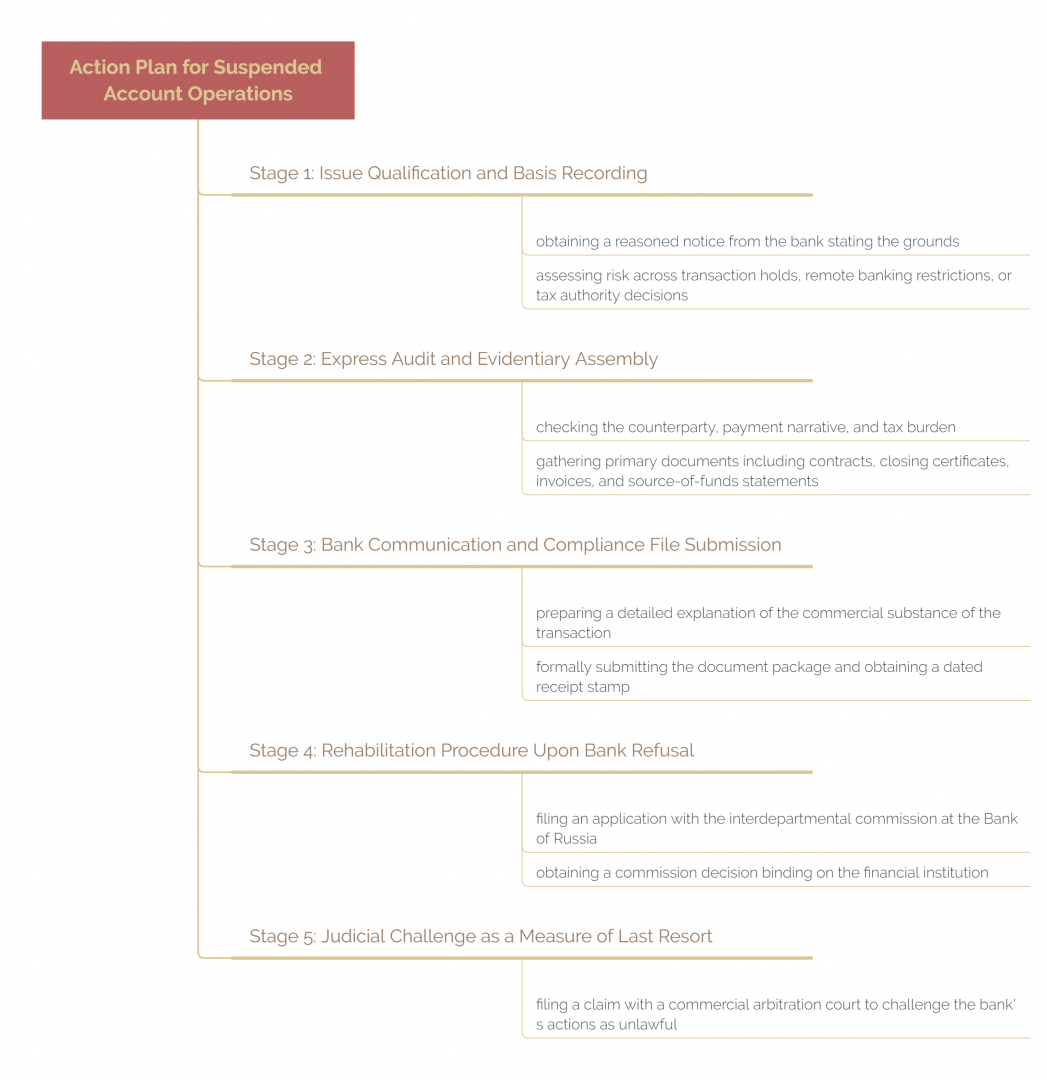
Five-Step Action Plan After Account Suspension
1. Request a Written Explanation of the Restriction
Under anti-money laundering and counter-terrorist financing rules, a bank must provide information on why a transaction was suspended or remote banking access was restricted. Submit a formal written inquiry through available bank channels or at a branch requesting the specific internal control rule provisions and statutory articles cited, together with the full list of documents required to lift the restriction.
2. Run an Express Audit of the Flagged Transaction
Before drafting a response, review contract execution for the suspended transfer, counterparty profile indicators, payment narrative accuracy, alignment with registered business activity codes, and tax burden relative to recent debit turnover. Mismatches across these indicators frequently trigger automated compliance alerts.
3. Prepare a Written Explanation and Compliance Dossier
Draft a clear explanation detailing the commercial logic of the transaction, production or delivery cycle, logistics, and final purpose. Attach copies of the underlying contract, annexes, specifications, primary accounting and transfer documents, staffing records, and tax payment confirmations, with copies duly certified according to company and bank rules.
4. Submit the Package and Track Statutory Deadlines
Deliver the completed dossier through the online banking portal if remote access remains active, or through the bank's incoming correspondence desk with a dated receipt stamp on your copy. The bank has seven business days to review the explanation and supporting records and must either resume operations or issue a reasoned written refusal.
5. Escalate to the Central Bank Interdepartmental Commission
If the bank issues a repeat refusal and keeps restrictions in place, submit a review application to the interdepartmental commission at the Bank of Russia through its online reception portal together with the initial bank inquiry, submitted documents, and written refusal. The commission issues a decision within 20 business days that is binding on the bank.
Actions to Avoid During an Account Restriction
Improper steps during a compliance hold can push a company into the high-risk tier of the central bank's client-risk platform and trigger broader account closures:
- ignoring compliance inquiries, which can lead the bank to treat the transaction as suspicious, terminate the account agreement unilaterally, and report the refusal to financial intelligence authorities;
- rushing to move remaining balances via payroll, dividends, or transfers to sole proprietors and individuals, which compliance systems may flag as cash-out attempts and trigger immediate blocks on linked accounts and cards;
- opening an account at another bank before resolving the hold, as real-time risk monitoring can cause immediate refusal or post-funding blocks.
Comparison of Escalation and Dispute Channels
Choosing the right escalation path depends on whether the bank has issued an initial hold, a repeat refusal, or a dispute requiring formal legal remedies.
|
Parameter |
Bank Compliance Team |
Central Bank Interdepartmental Commission |
Commercial Arbitration Court |
|
review timeline |
up to 7 business days |
up to 20 business days |
from 2 to 6 months |
|
binding effect of decision |
determined by the bank |
binding on the bank |
legally binding enforcement |
|
filing format |
online banking portal or bank desk |
central bank online reception portal |
formal court statement of claim |
|
evidentiary scope |
primary transaction documents |
full document set and correspondence |
procedural proof of claims and damages |
|
repeat refusal risk |
high if explanations are weak |
moderate under independent review |
low where supported by case practice |
Navigating Legal and Regulatory Risks in Account Restrictions
Account suspension is a formal compliance procedure that requires disciplined documentation rather than workarounds through alternative payment channels. Structured explanations of commercial substance and step-by-step escalation through bank and regulatory review mechanisms help restore normal banking operations and protect corporate standing. Where a company faces complex transaction histories, repeat compliance refusals, or disputes over account restrictions, engaging the legal specialists at KDpartners helps prepare evidentiary dossiers and manage regulatory escalation.
FAQ
Can a company pay salaries and taxes when remote banking access is restricted?
How does a single-transaction refusal differ from a remote banking restriction?
How can a company check whether it is placed in the high-risk tier on the central bank platform?
Can funds be transferred to another bank if the bank terminates the account under anti-money laundering rules?
Can an account be flagged if taxes are paid through a different bank?
How long does a bank take to review documents submitted to lift an account hold?

Key Terms
A
Account Blocking
B
Bank Account Secrecy
B
Basel Accords (Basel I, II, III)
C
Client-Bank (Internet Banking)
C
Correspondent Account
C
Currency Control
C
Customer Due Diligence (KYC)
I
Impossibility of Performing Payment Obligations
K
Know Your Customer (KYC)
M
Mandatory Reserve Requirements (Central Bank)
R
Regulatory Reporting
Related articles
All articles
What to Do If a Bank Suspends Account Operations in Russia
When a bank suspends account operations or restricts remote banking access, responding within the statutory review window—where banks generally have up to seven business days to assess submitted explanations and central bank interdepartmental reviews take up to 20 business days—is essential to prevent account termination or high-risk classification. Financial institutions enforce anti-money laundering and counter-terrorist financing rules alongside central bank risk-scoring algorithms and automated client-risk platform checks, making accurate classification of the restriction the first step. This guide sets out a five-step response workflow, highlights actions that worsen compliance exposure, compares escalation channels, and answers core operational questions.

How to Open a Bank Account in Hong Kong for Foreign Companies
Opening a bank account in Hong Kong typically takes from one to three weeks through payment platforms, three to five weeks via virtual banks, or six to ten weeks at traditional banks, with minimum balance requirements ranging from zero to $50,000 depending on the institution. While Hong Kong remains a central trade and settlement hub for the Asia-Pacific region—supporting transactions in Chinese yuan, Hong Kong dollars, and United Arab Emirates dirhams—regulatory oversight by the Hong Kong Monetary Authority and banking compliance teams enforces strict enhanced due diligence on cross-border ownership structures, commercial substance, and fund provenance. This guide sets out a six-step account opening workflow for foreign companies, compares Hong Kong financial institutions, identifies common compliance failure points, and answers core operational and tax questions.

Moving Large Capital Abroad from Russia: Routes, Compliance, and Risk Controls
Moving substantial private or corporate capital out of Russia requires tailored payment routing and pre-transaction legal files—with timelines ranging from minutes to 24 hours via digital asset channels or three to 15 business days and longer via banking and investment routes—because the primary compliance bottleneck sits with foreign correspondent and receiving banks rather than basic domestic transfer rules. Foreign financial institutions evaluate large transfers through three-to-five-year source-of-funds and source-of-wealth documentation alongside sanctions screening across ultimate beneficial owners, executives, banks, and logistics hubs, while domestic currency control, counter-sanctions, and anti-money laundering rules govern the Russian side. This guide examines four capital transfer routes, compares their timelines, costs, and compliance profiles, outlines key regulatory questions, and details risk controls for cross-border capital movements.
Contact us
Leave a request and our lawyers will contact you as soon as possible to provide a free consultation on your issue.
