Date:
21.11.2026
Reading time:
10 minutes
Author:

Daniil Kadyrov
Managing Partner
Moving Large Capital Abroad from Russia: Routes, Compliance, and Risk Controls
Date:
21.11.2026
Reading time:
10 minutes
Article
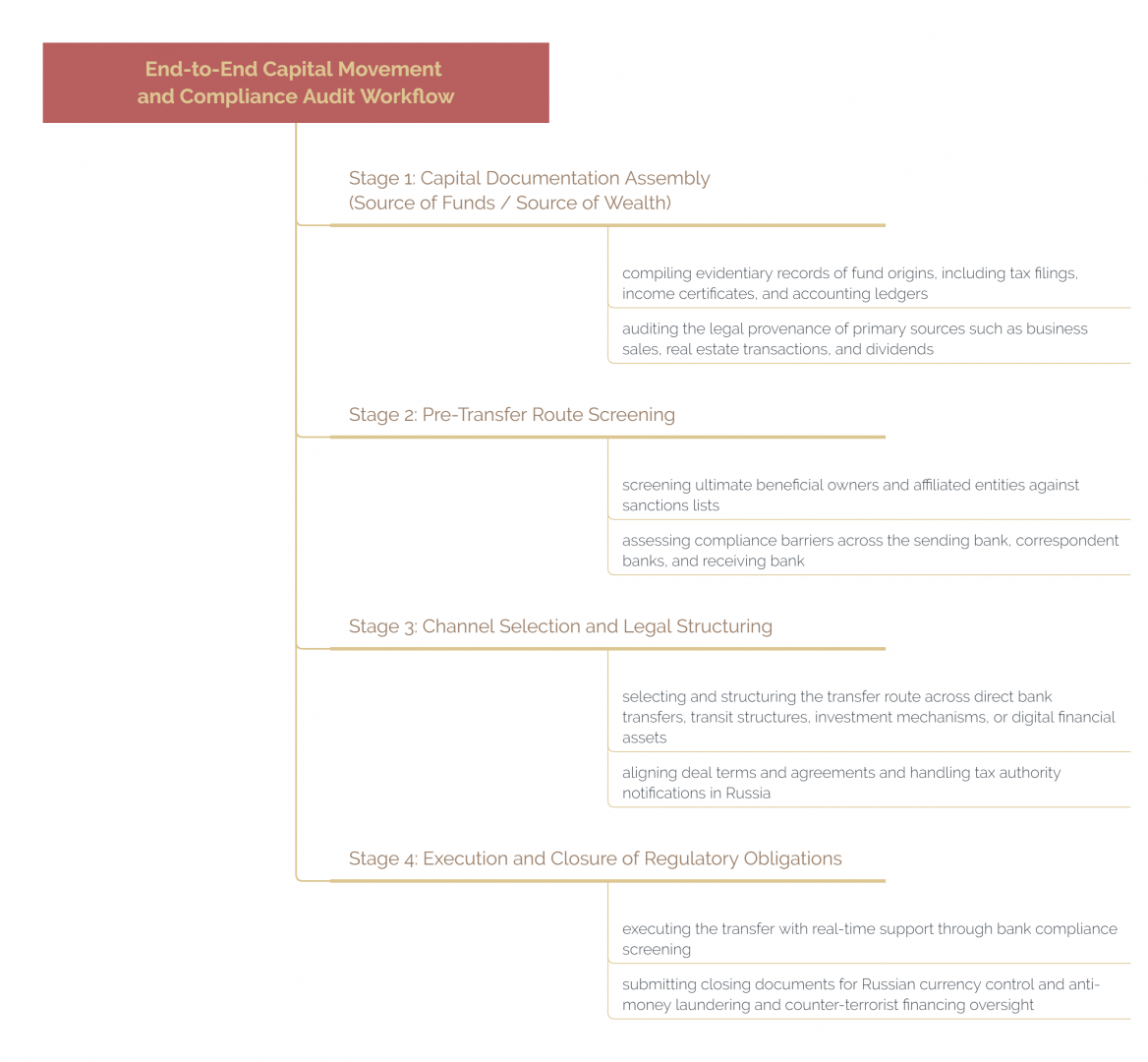
Introduction 1. Direct Bank Transfers Through Non-Sanctioned Banks 2. Routing Through Friendly Jurisdictions 3. Investment Mechanisms Across Real Assets and Mergers and Acquisitions 4. Digital Financial Assets and Legalized Digital Currency Channels Comparison of Capital Transfer Channels Navigating Legal and Regulatory Risks in Cross-Border Capital TransfersMoving substantial private or corporate capital out of Russia requires tailored payment routing and pre-transaction legal files—with timelines ranging from minutes to 24 hours via digital asset channels or three to 15 business days and longer via banking and investment routes—because the primary compliance bottleneck sits with foreign correspondent and receiving banks rather than basic domestic transfer rules. Foreign financial institutions evaluate large transfers through three-to-five-year source-of-funds and source-of-wealth documentation alongside sanctions screening across ultimate beneficial owners, executives, banks, and logistics hubs, while domestic currency control, counter-sanctions, and anti-money laundering rules govern the Russian side. This guide examines four capital transfer routes, compares their timelines, costs, and compliance profiles, outlines key regulatory questions, and details risk controls for cross-border capital movements.
Four Capital Transfer Routes and Their Mechanics
1. Direct Bank Transfers Through Non-Sanctioned Banks
This route sends foreign currency directly from an account at a Russian bank not subject to blocking sanctions to a recipient account abroad, typically in accessible currencies such as Chinese yuan, United Arab Emirates dirhams, Turkish lira, or Serbian dinars, or occasionally in dollars or euros where correspondent channels remain open.
Before generating a payment instruction, counsel prepares a compliance package containing a legal rationale for the transfer, source-of-funds and source-of-wealth documentation, and non-dual-use or non-sanctions undertakings.
Advantages of direct bank transfers include:
- a direct bank-to-bank path without third-party payment agents;
- straightforward currency control closure and tax accounting in Russia;
- transparent fees consisting of sending-bank and correspondent-bank charges.
Disadvantages of direct bank transfers include:
- elevated risk of delay or return at a foreign correspondent bank;
- a narrower set of supported currencies and destination jurisdictions;
- strict limits and higher premium-service tariffs at remaining international-settlement banks in Russia.
2. Routing Through Friendly Jurisdictions
Under this structure, capital moves from Russia to an account held by an individual or holding company in a friendly jurisdiction—such as the United Arab Emirates, Kazakhstan, Serbia, or Armenia, including structures in the Astana International Financial Centre or United Arab Emirates free zones—and is then forwarded to a target jurisdiction in Europe, the United Kingdom, or Asia as an investment, dividend distribution, or subsidiary capital contribution.
Advantages of routing through friendly jurisdictions include:
- breaking a direct transfer chain between Russia and the target jurisdiction, which reduces rejection risk at the final bank;
- access to international legal frameworks such as English common law in special financial zones;
- establishing a permanent offshore hub for ongoing asset management and recurring payments.
Disadvantages of routing through friendly jurisdictions include:
- higher upfront costs for entity formation, residence permits, and local substance;
- dual compliance screening across both the intermediate hub and the final receiving bank;
- Russian tax exposure under controlled foreign company rules and automatic financial account information exchange.
3. Investment Mechanisms Across Real Assets and Mergers and Acquisitions
Capital is deployed abroad through direct investment into commercial or residential real estate, foreign securities, equity stakes in operating businesses, or mergers and acquisitions, with funds wired to an escrow agent, institutional seller, or dedicated deal account under international transaction agreements and required regulatory approvals.
Advantages of investment mechanisms include:
- stronger receptivity from foreign banks and regulators when a transaction is backed by tangible investment assets;
- legal pathways to residence or citizenship by investment in qualifying jurisdictions;
- capital preservation against inflation through hard-asset allocation.
Disadvantages of investment mechanisms include:
- lower liquidity and potential discounts if assets must be converted back into cash quickly;
- heavier legal documentation involving audits, independent valuations, and thorough due diligence;
- need to account for Russian government commission approvals when acquiring assets from persons connected to unfriendly states.
4. Digital Financial Assets and Legalized Digital Currency Channels
This route uses hybrid digital rights, digital financial assets, and legalized digital currency channels under updated Russian legislation governing cross-border settlements and experimental legal regimes through licensed intermediaries—such as brokers or exchange operators in the Bank of Russia register—and digital depositories.
The workflow typically converts non-cash rubles into a digital asset via a licensed Russian operator, transfers the asset to a verified depository identifier, and sells or converts it abroad through accredited platforms while documenting foreign currency proceeds or investment inflows.
Advantages of digital asset channels include:
- rapid execution without relying on traditional correspondent banking chains;
- transparency before Russian authorities when executed within the Bank of Russia licensed perimeter;
- access to corridors disconnected from standard correspondent banking links with Russia.
Disadvantages of digital asset channels include:
- strict statutory boundaries, as domestic payments in digital currency are prohibited in Russia while cross-border operations and qualified investor rules apply;
- stringent anti-money laundering checks on wallet histories and fiat source of funds;
- infrastructure requirements to operate strictly through registered intermediaries.
Comparison of Capital Transfer Channels
Selecting a transfer channel requires balancing execution speed, compliance friction, transaction costs, and liquidity against the specific purpose of the capital movement.
|
Parameter |
Direct Bank Transfer |
Friendly Jurisdiction Transit |
Investment and Mergers & Acquisitions |
Digital Assets Channel |
|
destination scope |
limited jurisdictions including Commonwealth of Independent States, China, United Arab Emirates, Serbia, and select European banks |
broad reach to Europe, the United Kingdom, the United States, or Asia via an intermediate hub |
jurisdictions with investment programs, real estate markets, or direct corporate deals |
jurisdictions with accredited exchanges and licensed intermediaries |
|
execution timeline |
3 to 15 business days, with frequent correspondent delays |
2 to 5 business days after initial entity and account setup |
14 days to several months depending on registration and approvals |
from a few minutes to 24 hours |
|
compliance risk level |
high due to correspondent bank holds or returns |
moderate, reduced by initial vetting in the intermediate hub |
low to moderate due to identifiable underlying asset backing |
high due to wallet anti-money laundering and fiat source checks |
|
estimated total costs |
1% to 3% in sending and correspondent bank fees |
3% to 7% including entity upkeep, substance, and conversions |
2% to 5% in legal, notarial, registration, and due diligence expenses |
1.5% to 4% in conversion spreads, platform fees, and broker charges |
|
legal complexity in Russia |
low under standard currency control closure |
moderate given controlled foreign company and tax residency rules |
high when government commission approvals apply to unfriendly-state counterparties |
moderate under digital financial asset and cross-border experiment rules |
|
exit liquidity |
high as funds arrive in bank cash |
high via direct credit to a corporate or personal account |
lower while capital is tied up in real estate or private equity |
high upon conversion into local fiat currency |
|
primary use case |
recurring settlements with friendly states and local-currency contracts |
moving large private wealth and structuring family holdings or trusts |
structuring relocation, residence or citizenship options, and asset protection |
urgent liquidity transfers or corridors lacking correspondent banks |
Navigating Legal and Regulatory Risks in Cross-Border Capital Transfers
No single transfer route is universally risk-free, as each carries distinct regulatory limits, evidentiary standards, and banking compliance hurdles. Transaction success depends less on currency choice or sending bank alone than on pre-transfer preparation—assembling a complete source-of-funds and source-of-wealth dossier, verifying legal deal structure, and clearing routing parameters with financial institutions in advance. Where multi-jurisdiction structures, counter-sanctions or currency rules, or complex compliance reviews arise, engaging the legal specialists at KDpartners helps evaluate transaction risks, prepare supporting documentation, and coordinate cross-border execution.
FAQ
Can individuals use digital currencies to move personal capital abroad?
What happens if a correspondent bank's compliance team freezes a cross-border transfer?
How do dividend payouts and loans from Russian companies to foreign entities work under current restrictions?
What documents do foreign banks require to verify source of funds and source of wealth?
Must a Russian tax resident notify tax authorities when transferring large capital to a personal foreign account?

Key Terms
K
Know Your Customer (KYC)
O
OFAC (Office of Foreign Assets Control)
S
Sanctions Due Diligence
S
Sanctions Screening
S
SDN List (Specially Designated Nationals)
U
UBO Check (Ultimate Beneficial Owner Check)
Related articles
All articles

E-Commerce Operations Between China and International Markets: Tax, Customs, Payment Compliance, and Dispute Protection
Cross-border e-commerce between China and international markets requires full customs declarations, jurisdiction-specific product compliance and labeling, and verifiable payment chains—where structured tax and customs planning preserves input tax recovery and prevents cargo holds, while informal shipping routes and unverified payment intermediaries expose foreign sellers and brands to inventory seizures, account freezes, and regulatory penalties. As online marketplaces and customs authorities tighten enforcement around cross-border trade, manufacturers, brand owners, and sellers moving goods from China into target jurisdictions face scrutiny over customs valuation, origin and product safety rules, cross-border fund repatriation, and marketplace enforcement. This guide sets out the core operating principles for China-to-international-market e-commerce, compares operating models, and addresses key customs, tax, payment, and marketplace dispute questions.

What to Do If a Bank Suspends Account Operations in Russia
When a bank suspends account operations or restricts remote banking access, responding within the statutory review window—where banks generally have up to seven business days to assess submitted explanations and central bank interdepartmental reviews take up to 20 business days—is essential to prevent account termination or high-risk classification. Financial institutions enforce anti-money laundering and counter-terrorist financing rules alongside central bank risk-scoring algorithms and automated client-risk platform checks, making accurate classification of the restriction the first step. This guide sets out a five-step response workflow, highlights actions that worsen compliance exposure, compares escalation channels, and answers core operational questions.

How to Open a Bank Account in Hong Kong for Foreign Companies
Opening a bank account in Hong Kong typically takes from one to three weeks through payment platforms, three to five weeks via virtual banks, or six to ten weeks at traditional banks, with minimum balance requirements ranging from zero to $50,000 depending on the institution. While Hong Kong remains a central trade and settlement hub for the Asia-Pacific region—supporting transactions in Chinese yuan, Hong Kong dollars, and United Arab Emirates dirhams—regulatory oversight by the Hong Kong Monetary Authority and banking compliance teams enforces strict enhanced due diligence on cross-border ownership structures, commercial substance, and fund provenance. This guide sets out a six-step account opening workflow for foreign companies, compares Hong Kong financial institutions, identifies common compliance failure points, and answers core operational and tax questions.
Contact us
Leave a request and our lawyers will contact you as soon as possible to provide a free consultation on your issue.
