Date:
21.11.2026
Reading time:
10 minutes
Author:

Daniil Kadyrov
Managing Partner
Seven Legal Criteria for Establishing Force Majeure in Supply Contracts
Date:
21.11.2026
Reading time:
10 minutes

Article
Introduction Seven Criteria for Qualifying Force Majeure in Court Distinguishing Commercial Risk From Force Majeure Drone Strikes, Hostilities, and Security Incidents Sanctions Restrictions and Embargoes Natural Disasters and Weather Conditions Five-Step Action Plan for Suppliers During Force Majeure Navigating Legal and Regulatory Risks in Supply DisputesEstablishing force majeure in supply contracts requires meeting seven cumulative legal criteria—where failing even one element can expose a supplier to liquidated damages, unilateral termination, and inclusion on public procurement blacklists—while routine price spikes, currency swings, and counterparty delays generally remain commercial risk. Under Russian civil law, antitrust enforcement practice, and commercial court rulings, parties cannot rely on general references to market instability or external tensions without documented proof of objective impossibility and causal impact. This guide sets out the seven qualification criteria, compares commercial risk against force majeure, reviews judicial case outcomes, provides a five-step action sequence, and answers key questions.
Seven Criteria for Qualifying Force Majeure in Court
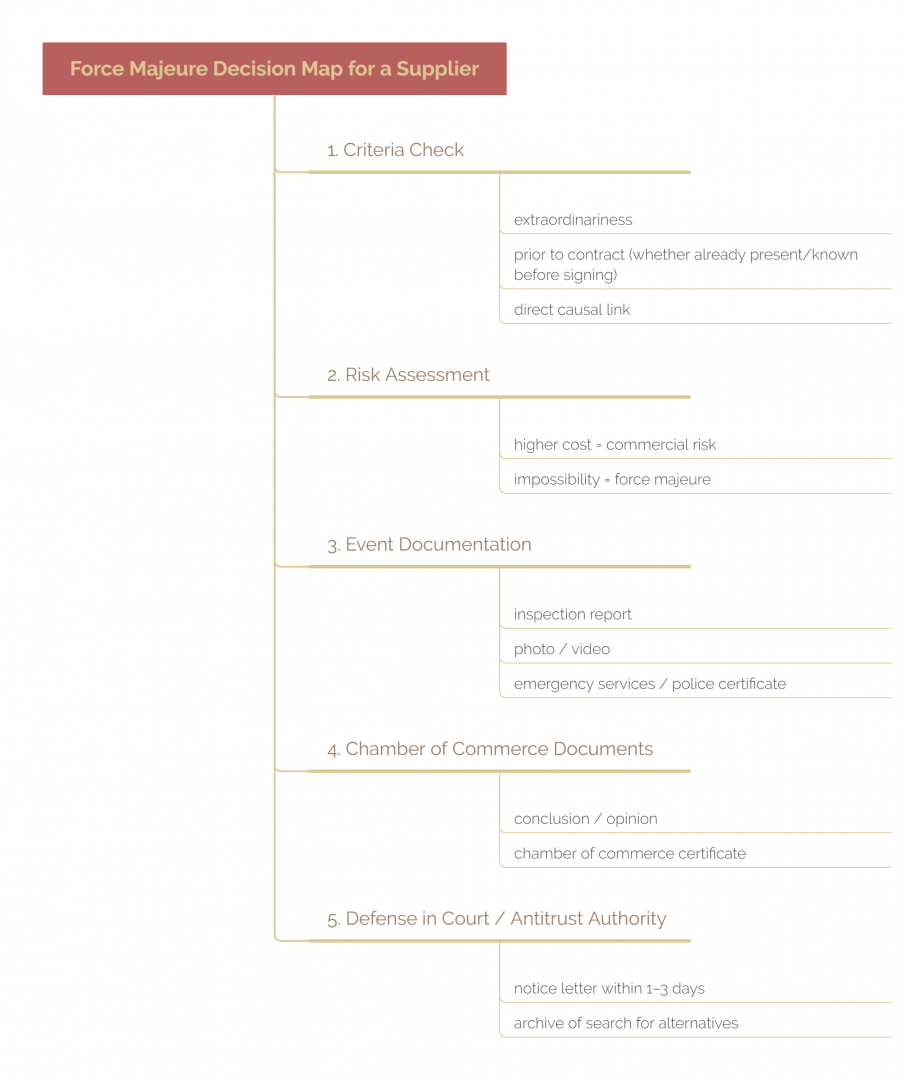
Commercial arbitration courts and antitrust authorities evaluate the full factual record and require all seven legal elements to be met simultaneously:
- extraordinariness and unavoidability, meaning an exceptional event outside normal operating conditions and business risk that no comparable market participant could prevent or avoid its consequences using reasonable available measures;
- occurrence strictly after contract execution, because restrictions, sanctions listings, emergency regimes, or adverse weather already existing or officially announced at signing are treated as voluntarily assumed risk;
- direct impact on the specific asset or performance process, requiring proof that the event affected the actual production line, warehouse holding the finished goods, sole available transport corridor, or critical infrastructure such as bridges, ports, or power nodes rather than merely a neighboring region or general economic climate;
- official documentary proof, since media reports, social-media posts, or oral statements are insufficient without admissible records from competent authorities such as a chamber of commerce assessment or certificate, emergency services records, meteorological agency statements, or law-enforcement and defense records;
- direct causal link, establishing a clear chain from the qualifying event to the specific obstacle that made performing the contractual obligation physically or legally impossible rather than merely costlier or more difficult;
- compliance with contractual notice rules and deadlines, meaning timely dispatch within the contract window—or promptly, typically within one to three business days if unspecified—via an authorized channel such as an electronic procurement portal, registered mail with inventory, or official electronic document exchange accompanied by initial evidence and a preliminary schedule impact;
- documented mitigation measures, showing good-faith effort as a prudent market participant through inquiries to alternative suppliers, evaluation of alternative logistics routes even at higher cost, and formal proposals to the counterparty for schedule adjustments or phased delivery.
Distinguishing Commercial Risk From Force Majeure
Conflating ordinary business risk with force majeure is a primary reason suppliers lose disputes in commercial arbitration courts and face placement on procurement blacklists. Under civil liability rules, counterparty breaches by suppliers, carriers, or subcontractors, unavailability of goods on the market, lack of funds, and currency fluctuations do not by themselves constitute force majeure.
|
Parameter |
Commercial Risk |
Force Majeure |
|
core nature of event |
adverse market shifts, supply chain friction, or financial strain |
extraordinary, unavoidable external event of an absolute character |
|
typical examples |
input or freight price hikes, subcontractor or carrier failure, vehicle or equipment breakdown, cash-flow gaps, or routine seasonal weather |
official bans, embargoes, or direct border closures, armed hostilities, attacks or infrastructure damage, natural disasters, or state-declared emergencies and quarantines |
|
effect on performance |
makes performance more expensive or commercially unattractive |
makes performance objectively impossible physically or legally |
|
legal consequences |
supplier must perform at own expense or bear penalties, damages, and potential procurement blacklisting |
relieves supplier from penalties and damages for the affected period, though unspent advances generally must be refunded |
Courts apply a baseline rule that if a contract can still be performed—even at higher cost or with route adjustments—the situation remains a commercial risk. For example, a doubling of factory prices or freight tariffs is a commercial risk requiring performance on agreed terms or negotiated termination, whereas destruction of the sole facility producing custom-specification goods with no market substitutes can qualify as force majeure.
Judicial Practice Across Key Risk Categories
Drone Strikes, Hostilities, and Security Incidents
General references to hostilities, special security regimes, or drone threats do not automatically excuse non-performance without proof of a direct physical or logistical barrier. Courts have recognized force majeure where an attack on a key bridge blocked transport and created multi-day bottlenecks, supported by a chamber of commerce conclusion and the absence of safe alternative routes near active hostilities; conversely, courts have rejected claims based on general security threats where the contract was signed after those conditions were already known and direct property damage to the performance asset was unproven.
Sanctions Restrictions and Embargoes
Foreign trade sanctions or embargoes support a force-majeure defense only when they impose a direct prohibition and take effect after the contract is executed. Courts have sided with suppliers where post-contract export bans barred shipment of specialized dual-use equipment and the supplier proved uniqueness, manufacturer refusal, attempts to source alternatives via third countries, and timely notice, while rejecting defenses where key sanctions predated contracting or the contract allowed sourcing from alternative suppliers.
Natural Disasters and Weather Conditions
Routine seasonal weather such as standard rain, snow, or cold temperatures is treated as normal operating conditions, whereas abnormal extreme events confirmed by meteorological authorities can qualify. Courts have accepted force majeure where official weather records documented severe sea conditions and storm winds barring vessel berthing and unloading under safety rules, while rejecting claims over heavy seasonal rain where a professional contractor failed to arrange routine site drainage and equipment protection.
Five-Step Action Plan for Suppliers During Force Majeure
When an event threatens contract performance, disciplined execution preserves legal defenses against penalties and procurement blacklisting:
- document the event immediately during the first 24 to 48 hours by forming an internal—and where possible independent—commission to record site, warehouse, or plant conditions, taking dated, geotagged photos and videos, and requesting official records from emergency, meteorological, police, or transport authorities;
- notify the counterparty in strict compliance with the contract's notice clause and deadline—typically one to five days, or immediately if none is stated—using a contractually valid channel and attaching initial proof, causal explanation, and proposed next steps;
- obtain a chamber of commerce assessment or certificate by submitting the contract, primary agency records, specifications, and correspondence to the competent chamber, noting that domestic transactions typically use a regional chamber assessment while foreign trade contracts use a chamber certificate issued at the central level;
- initiate structured negotiations to amend delivery schedules or routes where temporary, or seek termination without mutual penalties under statutory impossibility rules where performance is permanently impossible;
- maintain a chronological evidentiary archive containing the contract, notices, site and agency records, chamber documents, mitigation inquiries, and counterparty responses for use in administrative or court proceedings.
Navigating Legal and Regulatory Risks in Supply Disputes
Evaluating force majeure amid sanctions regimes, currency controls, and strict statutory deadlines requires early legal review before notices are sent or contract remedies are triggered. Relying on informal assumptions about external events or missing procedural steps can turn a defensible position into uncontested liability or a procurement blacklist entry. Where your company faces disputed delivery delays, termination demands, or evidentiary challenges under a supply contract, engaging the legal team at KDpartners helps assess legal grounds, prepare chamber and court documentation, and protect your commercial interests.
FAQ
Is mobilization of key staff or management treated as force majeure?
Can a supplier unilaterally cancel a contract immediately upon force majeure?
Does obtaining a chamber of commerce force-majeure document count toward the deadline to notify the customer?
Does force majeure release a supplier from returning an advance payment received from the customer?
Can a supplier claim force majeure due to late payment by a public or commercial customer?
How can a supplier prove force majeure if a chamber of commerce refuses to issue a conclusion or certificate?

Key Terms
A
Arbitrazh Court (Arbitration Court)
C
Compensation for Damages / Recovery of Losses
C
Contractual Penalty
D
Dual-Use Goods Export Restrictions
I
Impossibility of Performing Payment Obligations
I
Incoterms
P
Pre-Trial Dispute Resolution (Settlement)
P
Pre-Trial Work (Claim Procedure)
S
Sanctions Clause in Contracts
T
Termination of Obligations on Sanctions Grounds
Related articles
All articles

Fuel Supply Disruptions as Force Majeure: Commercial Court Case Law
Fuel shortages, drone strikes on refineries, industrial accidents, and sharp price swings rarely qualify as force majeure in fuel supply disputes, with commercial arbitration courts across recent rulings through 2026 relieving suppliers only in narrow cases such as sovereign transport prioritization while enforcing penalties, advance refunds, or full performance where fuel is treated as generic goods, contracts were signed amid known risks, or alternative sourcing remained possible. For international investors, commodity traders, and cross-border counterparties operating in or trading with Russia, fuel supply disputes also intersect with sanctions compliance, counter-sanctions measures, currency controls, cross-border payment channels, KYC/AML rules, and document legalization requirements. This guide reviews seven commercial court decisions and chamber guidance, compares judicial positions, outlines a five-step response sequence and contract drafting safeguards, and answers key questions.

Extreme Weather as Force Majeure in Supply and Construction Contracts: Case Law
Extreme weather events—including severe storms, deep frosts, droughts, floods, and hurricanes—do not automatically excuse late delivery, works delays, or cargo damage in commercial arbitration disputes, where courts require simultaneous proof of extraordinariness and unavoidability backed by official meteorological records and active mitigation. Across commercial arbitration rulings, courts distinguish rare climatic anomalies from routine seasonal fluctuations that suppliers and contractors are expected to factor into schedules, engineering plans, and pricing, while international counterparties operating in or trading with Russia must also account for sanctions compliance, currency controls, cross-border payment channels, and document legalization rules. This guide reviews seven commercial court decisions, compares judicial positions across weather scenarios, sets out a five-step response sequence, and answers key questions.

Sanctions as Force Majeure in Supply Contracts: Commercial Court Case Law
Sanctions and export restrictions do not automatically excuse missed deliveries in supply contracts, with commercial arbitration courts and antitrust authorities across recent rulings between 2022 and 2026 relieving suppliers only where post-contract bans caused objective impossibility backed by direct proof and documented mitigation, while enforcing penalties and procurement blacklisting where contracts were signed amid known restrictions or where causation and alternative sourcing went unproven. For foreign investors, international manufacturers, and cross-border counterparties trading with or operating in Russia, sanctions disputes also intersect with counter-sanctions measures, currency controls, cross-border payment channels, KYC/AML compliance, and document legalization rules. This guide analyzes six commercial court and antitrust cases, compares judicial outcomes, sets out a five-step supplier response sequence, and answers key questions.
Contact us
Leave a request and our lawyers will contact you as soon as possible to provide a free consultation on your issue.
