Date:
21.11.2026
Reading time:
12 minutes
Author:

Daniil Kadyrov
Managing Partner
Fuel Supply Disruptions as Force Majeure: Commercial Court Case Law
Date:
21.11.2026
Reading time:
12 minutes
Article
Introduction Commercial Court Case Law on Fuel Supply Disruptions Fuel Cards and Vouchers Without Fuel at Filling Stations Price Spikes, Sanctions, and Fuel Shortages Refinery Damage From Drone Strikes on a Later Contract Refinery Accidents and Fuel as Generic Goods Logistics Barriers, Border Closures, and Causal Proof Chamber Documents, Third-Party Sales, and Third-Party Refineries Sovereign Priority for Military Rail Transport as a Narrow Exception Comparison of Commercial Court and Chamber Positions on Fuel Disputes Five-Step Action Sequence and Contract Safeguards for Fuel Suppliers Navigating Legal and Regulatory Risks in Fuel Supply DisputesFuel shortages, drone strikes on refineries, industrial accidents, and sharp price swings rarely qualify as force majeure in fuel supply disputes, with commercial arbitration courts across recent rulings through 2026 relieving suppliers only in narrow cases such as sovereign transport prioritization while enforcing penalties, advance refunds, or full performance where fuel is treated as generic goods, contracts were signed amid known risks, or alternative sourcing remained possible. For international investors, commodity traders, and cross-border counterparties operating in or trading with Russia, fuel supply disputes also intersect with sanctions compliance, counter-sanctions measures, currency controls, cross-border payment channels, KYC/AML rules, and document legalization requirements. This guide reviews seven commercial court decisions and chamber guidance, compares judicial positions, outlines a five-step response sequence and contract drafting safeguards, and answers key questions.
Commercial Court Case Law on Fuel Supply Disruptions
Commercial arbitration courts and chamber of commerce guidance evaluate fuel non-delivery by examining whether fuel is defined as generic goods or tied to a specific plant, whether risks existed when the contract was signed, and whether the supplier pursued alternative supply or documented sovereign orders.
Fuel Cards and Vouchers Without Fuel at Filling Stations
In a dispute over failed motor-fuel supply under a public contract where the buyer paid in advance and received fuel vouchers and cards, drivers repeatedly encountered filling stations with no fuel available, and the supplier refused to refund the advance on the ground that issuing vouchers and cards completed delivery amid market shortages. A commercial cassation court rejected the supplier's position and ordered full refund of the advance.
The court held that the contract's subject matter was the fuel itself rather than plastic cards or paper vouchers, which serve only as instruments for obtaining fuel later, so delivery occurs only upon actual refueling and transfer of fuel to the buyer, and station shortages do not excuse returning unearned prepayment.
Price Spikes, Sanctions, and Fuel Shortages
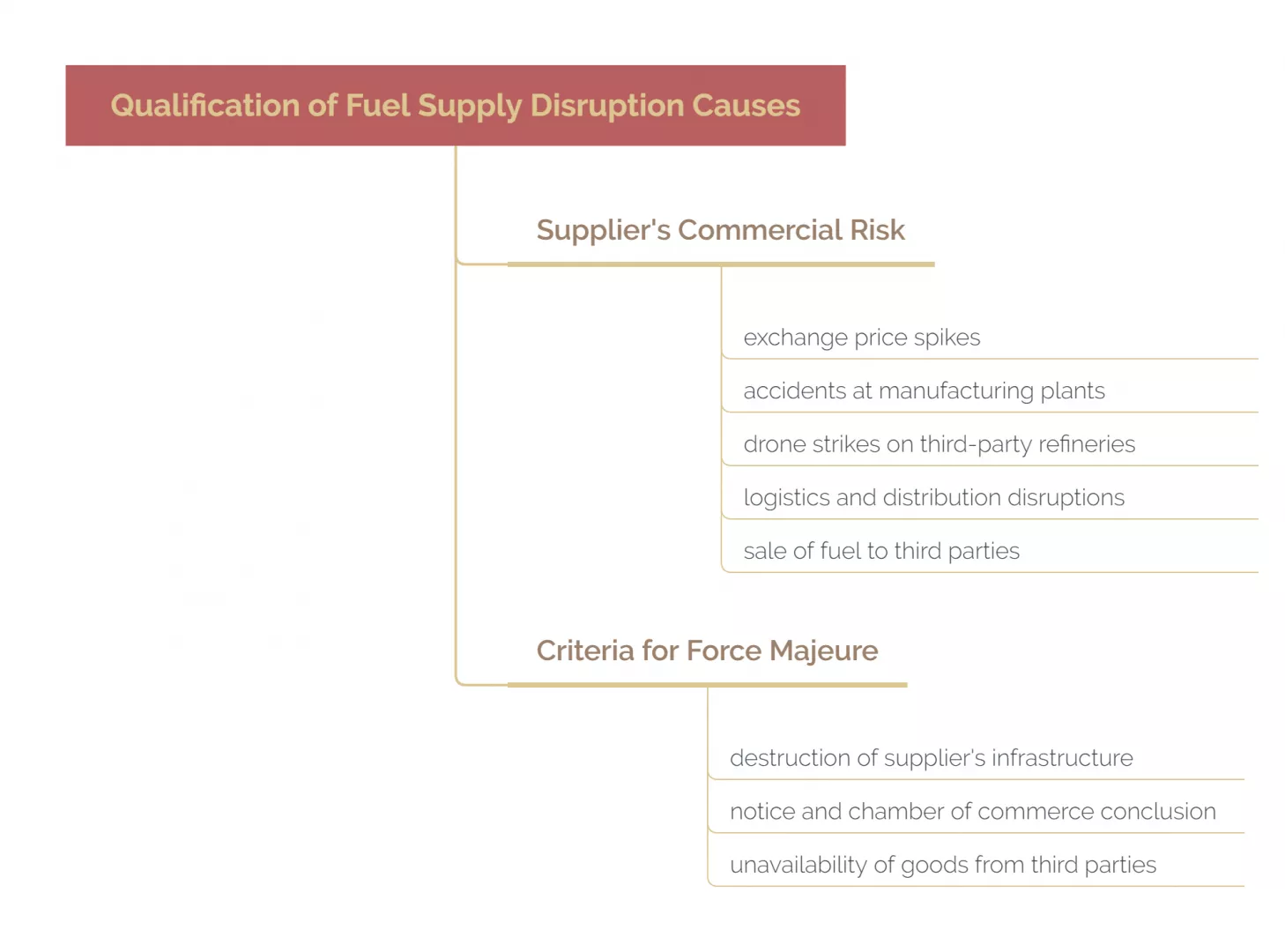
Where a fuel supplier failed to deliver under a supply contract and invoked force majeure based on rising purchase prices after early 2022, new economic sanctions against Russia, and domestic fuel shortages, a regional commercial arbitration court in August 2023 rejected the defense and awarded full penalties.
The court ruled that price changes, currency swings, and supply shortages are ordinary commercial risks assumed at contracting, sanctions had been introduced in stages since 2014 and were ongoing so a prudent market participant should have anticipated market volatility in pricing, and the supplier also failed to send timely notice or obtain a chamber of commerce force-majeure assessment.
Refinery Damage From Drone Strikes on a Later Contract
In a dispute over late and short fuel deliveries where the supplier claimed force majeure due to drone strike damage at an oil refinery halting processing and disrupting shipping schedules, a regional commercial arbitration court in May 2026 rejected the claim and awarded full fines and late-delivery penalties.
The court emphasized that the contract was signed in June 2025—more than three years after hostilities began—requiring a professional market participant to evaluate refinery infrastructure risks and price them into its commercial model, while the supplier presented no chamber of commerce certificate and records showed sufficient fuel stocks held by alternative holders in the region.
Refinery Accidents and Fuel as Generic Goods
Where a supplier was ordered to pay late-delivery and non-delivery penalties for motor fuel and cited an industrial accident at a refinery alongside force-majeure conclusions issued by a regional chamber of commerce, an appellate commercial arbitration court in May 2025 upheld the penalty award.
The court ruled that gasoline and diesel are generic goods by legal nature, and because the supply contracts did not require shipment exclusively from one specific refinery, a plant shutdown did not create absolute physical impossibility where the supplier could purchase comparable volumes from other market participants or exchanges. Moreover, the chamber conclusions came from a region different from the agreed delivery point, and evidence showed the supplier continued selling similar gasoline to third parties on other trading venues during the claimed force-majeure period.
Logistics Barriers, Border Closures, and Causal Proof
Where a supplier cited logistics disruptions, border closures, and transport restrictions to justify late delivery, a district commercial arbitration court in November 2024 vacated lower-court rulings and remanded the case for reconsideration.
The court held that transport barriers or restrictions do not automatically excuse liability; the supplier must prove a direct causal link between the specific restriction and non-delivery, the exact period of the barrier, and the absence of alternative transport routes or methods, as well as good-faith mitigation efforts.
Chamber Documents, Third-Party Sales, and Third-Party Refineries
Building on appellate rulings and chamber of commerce guidance issued in early 2026 following refinery incidents, courts and the chamber have taken a strict view of chamber documents where a supplier sells similar fuel to third parties or relies on incidents at third-party plants.
Selling identical fuel grades to other buyers during a claimed shortage undermines extraordinariness and unavoidability and undercuts chamber certificates, while chamber guidance clarifies that trading and distribution companies do not obtain force-majeure certificates for drone strikes or accidents at third-party refineries rather than their own facilities when operating under existing special regimes.
Sovereign Priority for Military Rail Transport as a Narrow Exception
In a dispute over delayed fuel railcars caused by mandatory rail bottlenecks from state decisions prioritizing military trains and defense cargo for the Ministry of Defense in the conflict zone, a district commercial arbitration court in January 2026 recognized force majeure and relieved the supplier of liability.
The court found that sovereign reallocation of rail capacity and forced schedule changes were extraordinary and unavoidable measures beyond the parties' control, while marking narrow boundaries: relief requires direct state measures—such as counter-terrorist operation regimes, martial law, or state transport requisition—rather than market shifts, commercial plant accidents, or price changes, alongside proof that comparable fuel was unavailable locally or at nearby supply points, documented mitigation and alternative sourcing as emphasized by constitutional court practice, timely notice, and chamber documentation evaluated with carrier and agency records.
Comparison of Commercial Court and Chamber Positions on Fuel Disputes
|
Supplier Argument or Scenario |
Court or Chamber Position |
Typical Case Outcome |
|
fuel vouchers or cards issued without fuel at filling stations |
vouchers are access instruments; delivery requires actual fuel transfer |
advance refunded to buyer |
|
price spikes, sanctions, and domestic fuel shortages |
price swings and ongoing sanctions since 2014 are commercial risks; notice and chamber proof absent |
full penalties awarded |
|
refinery drone strike under contract signed in June 2025 |
risks were known at signing; no chamber certificate and regional stocks existed |
full fines and penalties awarded |
|
refinery accident with regional chamber document and third-party sales |
fuel is generic without single-plant clause; sales to others refute shortage |
penalties upheld |
|
logistics disruptions, border closures, and transport limits |
direct causation, barrier window, absence of alternate routes, and mitigation must be proved |
case remanded for re-examination |
|
third-party refinery incident or sales to other buyers during shortage |
third-party plant incidents and selective third-party sales defeat force majeure and chamber proof |
penalties upheld; no certificate for third-party plant |
|
state priority rail movement for defense cargo in conflict zone |
sovereign transport decision is extraordinary and unavoidable if alternatives and mitigation are proved |
force majeure recognized and liability excused |
Five-Step Action Sequence and Contract Safeguards for Fuel Suppliers
When a supply disruption threatens fuel delivery schedules, disciplined execution and clear contract drafting help limit financial and procurement exposure:
- review contract terms and product identification immediately upon an incident to check whether fuel is defined as generic grades or tied to a named refinery or dispatch point, since generic terms generally require alternative sourcing unless a specific source is mandated;
- collect primary evidence from the manufacturer, rail carrier, road hauler, or logistics operator—including official notices or certificates stating the cause, date, and exact time of disruption—and send written notice to the buyer strictly within the contract's notice window, typically one to three business days;
- document searches for alternative supply across other producers, distributors, and commodity exchange quotes while recording written refusals or lack of available volumes at nearby dispatch points, and suspend spot sales of matching fuel grades to third parties during the disruption;
- apply to the competent regional chamber of commerce tied to the dispatch point or obstacle location for a force-majeure assessment or certificate where the incident occurred at your facility or a contractually specified facility, supported by contract, carrier, agency, and notice records;
- structure future fuel supply contracts with a specific refinery or dispatch point where applicable, an explicit list of sector risks including drone strikes, sabotage, refinery accidents, rail embargo orders, and sovereign transport priority, clear notice timelines and document lists, and termination rights without penalty if disruptions exceed a set period such as thirty calendar days.
Navigating Legal and Regulatory Risks in Fuel Supply Disputes
Commercial arbitration practice on fuel supply disruptions remains strict, treating price volatility, sanctions, logistics bottlenecks, and third-party refinery incidents as commercial risk unless direct sovereign measures or proven impossibility with full good-faith mitigation are established. For international investors, traders, and foreign-linked counterparties, managing fuel supply disputes also requires aligning contract terms and remedies with sanctions compliance, counter-sanctions rules, currency controls, cross-border payment channels, KYC/AML checks, and document legalization requirements. Where your company faces fuel non-delivery claims, penalty demands, blacklist risks, or contract audits, engaging the legal team at KDpartners helps evaluate force-majeure and contract positions, coordinate chamber and court filings, and protect your commercial interests.
FAQ
How do long-running sanctions and preventative contract clauses affect fuel supply risk?
When do commercial courts recognize force majeure for fuel transport delays?
How do courts treat fuel card or voucher deliveries when fuel is unavailable at filling stations?
Can a fuel trader or distributor blame drone strikes or refinery accidents for delayed deliveries?
Are wholesale fuel price spikes or commodity exchange price jumps treated as force majeure when performance becomes unprofitable?
Is a chamber of commerce force-majeure certificate or assessment enough to avoid penalties for late fuel delivery?

Key Terms
A
Arbitrazh Court (Arbitration Court)
C
Compensation for Damages / Recovery of Losses
C
Contractual Penalty
F
Fine (Penalty)
I
Impossibility of Performing Payment Obligations
L
Losses / Damages
P
Pre-Trial Dispute Resolution (Settlement)
P
Pre-Trial Work (Claim Procedure)
S
Sanctions Clause in Contracts
Related articles
All articles
Fuel Supply Disruptions as Force Majeure: Commercial Court Case Law
Fuel shortages, drone strikes on refineries, industrial accidents, and sharp price swings rarely qualify as force majeure in fuel supply disputes, with commercial arbitration courts across recent rulings through 2026 relieving suppliers only in narrow cases such as sovereign transport prioritization while enforcing penalties, advance refunds, or full performance where fuel is treated as generic goods, contracts were signed amid known risks, or alternative sourcing remained possible. For international investors, commodity traders, and cross-border counterparties operating in or trading with Russia, fuel supply disputes also intersect with sanctions compliance, counter-sanctions measures, currency controls, cross-border payment channels, KYC/AML rules, and document legalization requirements. This guide reviews seven commercial court decisions and chamber guidance, compares judicial positions, outlines a five-step response sequence and contract drafting safeguards, and answers key questions.

Extreme Weather as Force Majeure in Supply and Construction Contracts: Case Law
Extreme weather events—including severe storms, deep frosts, droughts, floods, and hurricanes—do not automatically excuse late delivery, works delays, or cargo damage in commercial arbitration disputes, where courts require simultaneous proof of extraordinariness and unavoidability backed by official meteorological records and active mitigation. Across commercial arbitration rulings, courts distinguish rare climatic anomalies from routine seasonal fluctuations that suppliers and contractors are expected to factor into schedules, engineering plans, and pricing, while international counterparties operating in or trading with Russia must also account for sanctions compliance, currency controls, cross-border payment channels, and document legalization rules. This guide reviews seven commercial court decisions, compares judicial positions across weather scenarios, sets out a five-step response sequence, and answers key questions.

Sanctions as Force Majeure in Supply Contracts: Commercial Court Case Law
Sanctions and export restrictions do not automatically excuse missed deliveries in supply contracts, with commercial arbitration courts and antitrust authorities across recent rulings between 2022 and 2026 relieving suppliers only where post-contract bans caused objective impossibility backed by direct proof and documented mitigation, while enforcing penalties and procurement blacklisting where contracts were signed amid known restrictions or where causation and alternative sourcing went unproven. For foreign investors, international manufacturers, and cross-border counterparties trading with or operating in Russia, sanctions disputes also intersect with counter-sanctions measures, currency controls, cross-border payment channels, KYC/AML compliance, and document legalization rules. This guide analyzes six commercial court and antitrust cases, compares judicial outcomes, sets out a five-step supplier response sequence, and answers key questions.
Contact us
Leave a request and our lawyers will contact you as soon as possible to provide a free consultation on your issue.
