Date:
21.11.2026
Reading time:
13 minutes
Author:

Daniil Kadyrov
Managing Partner
Sanctions as Force Majeure in Supply Contracts: Commercial Court Case Law
Date:
21.11.2026
Reading time:
13 minutes

Article
Introduction Commercial Court and Antitrust Practice on Sanctions Disputes Export Ban on Dual-Use Power Equipment With Active Mitigation Contracting After Major Sanctions Were Already in Force Defeating Procurement Blacklisting Amid Logistics Blockades and Cost Spikes Unsubstantiated Claims of Sanctions and General Tensions Chamber of Commerce Document Without Alternative Sourcing Proof Late Notice and Post-Facto Chamber Filing in Court Comparison of Judicial and Antitrust Outcomes on Sanctions Five-Step Action Sequence for Suppliers Facing Sanctions Navigating Legal and Regulatory Risks in Sanctions DisputesSanctions and export restrictions do not automatically excuse missed deliveries in supply contracts, with commercial arbitration courts and antitrust authorities across recent rulings between 2022 and 2026 relieving suppliers only where post-contract bans caused objective impossibility backed by direct proof and documented mitigation, while enforcing penalties and procurement blacklisting where contracts were signed amid known restrictions or where causation and alternative sourcing went unproven. For foreign investors, international manufacturers, and cross-border counterparties trading with or operating in Russia, sanctions disputes also intersect with counter-sanctions measures, currency controls, cross-border payment channels, KYC/AML compliance, and document legalization rules. This guide analyzes six commercial court and antitrust cases, compares judicial outcomes, sets out a five-step supplier response sequence, and answers key questions.
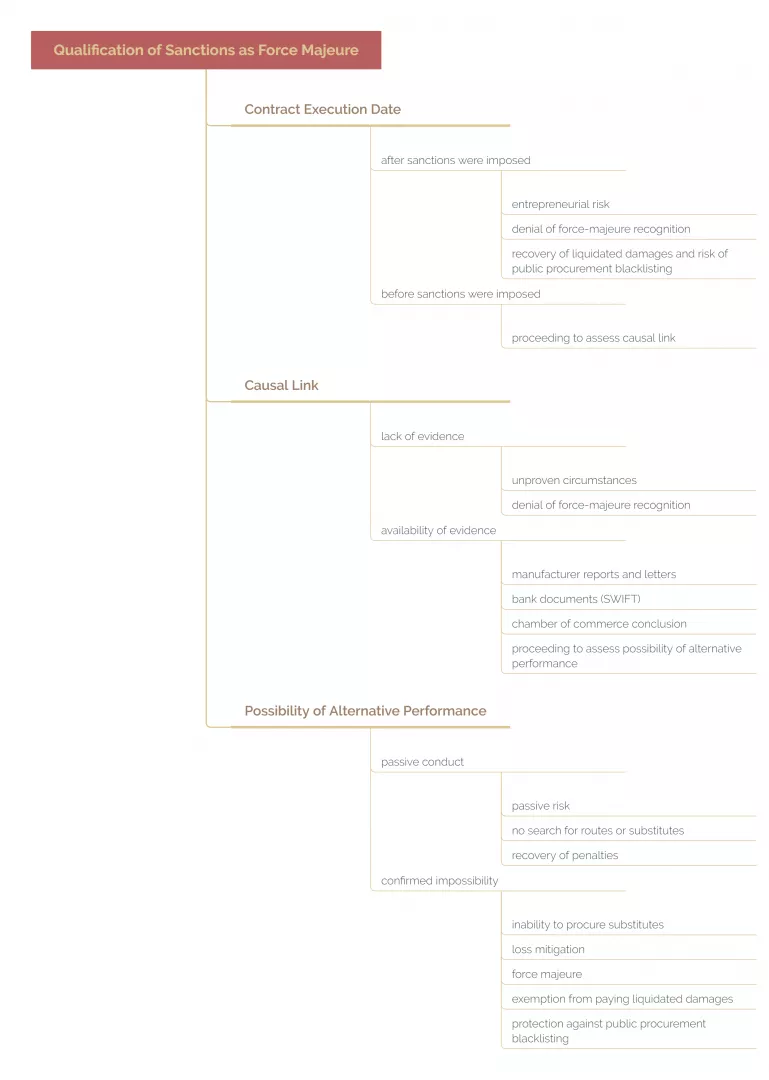
Commercial Court and Antitrust Practice on Sanctions Disputes
Commercial arbitration courts and antitrust authorities evaluate each dispute on contract execution dates, direct causal impact on the specific obligation, compliance with notice deadlines, and good-faith efforts to find alternatives rather than treating sanctions as a blanket excuse for non-performance.
Export Ban on Dual-Use Power Equipment With Active Mitigation
In a dispute involving specialized equipment for a power unit, European Union and United Kingdom sanctions prohibiting the export of dual-use goods prevented delivery of a second shipment after the manufacturer formally refused to supply. Although the supplier proposed alternatives—including routing via third countries, reverse engineering, and establishing a joint venture—the buyer rejected those options and sued for late-delivery penalties.
An appellate commercial arbitration court in February 2026 recognized force majeure, holding that the foreign public-law bans were extraordinary and unavoidable and that the equipment was custom-engineered for the power unit's technical parameters, precluding quick off-the-shelf substitutes. Because the supplier promptly notified the buyer and took reasonable steps to perform, the court denied penalties on the main delay period—awarding penalties only for the brief window before notice was sent and reducing them further under statutory penalty-reduction rules—confirming that timely notice and documented mitigation cut off liability from the point force majeure is notified.
Contracting After Major Sanctions Were Already in Force
In a dispute over delayed medical equipment deliveries, a supplier sought to excuse non-performance by citing general sanctions restrictions against Russia under a contract signed in April 2023. A cassation commercial arbitration court in February 2026 rejected the force-majeure defense and upheld full penalties.
The court ruled that core sanctions packages had already been in place for more than a year when the contract was signed, meaning the supplier should have anticipated logistics and commercial risks. Moreover, the supplier failed to prove a direct ban on the specific medical items, general export hurdles at foreign counterparties did not establish impossibility, public procurement records showed other market participants successfully delivered identical equipment during the same period, and the supplier neither sought alternative sellers nor requested contract amendments.
Defeating Procurement Blacklisting Amid Logistics Blockades and Cost Spikes
When a supplier faced cascading external sanctions in March 2022 after signing a supply contract, it purchased initial materials and contracted for components, but airspace closures and international logistics blockades delayed shipments and drove performance costs up from 2.5 million to 6 million rubles. After the buyer rejected two proposals for mutual termination without penalties and unilaterally terminated the contract, an antitrust authority refused to place the supplier on the public procurement blacklist.
The antitrust authority found no bad faith or intent where the supplier repeatedly informed the buyer, sought negotiated termination, and faced extraordinary, unavoidable logistics and cost shocks beyond its control. This outcome shows that early buyer communication, documented cost escalation, and good-faith negotiation proposals help protect a supplier's standing before antitrust bodies.
Unsubstantiated Claims of Sanctions and General Tensions
In a dispute over delayed railcar deliveries under a contract concluded in 2023, a carrier sought relief from penalties by citing international sanctions, martial law, and general risks of sabotage or attacks. An appellate commercial arbitration court in September 2024 rejected the defense and awarded full penalties.
The court noted that broad economic or security conditions do not automatically excuse commercial obligations without proof of a direct causal link between the cited measure and the specific railcar delay. Because the contract was signed in 2023 after 2022 logistics disruptions were already widely known, the carrier was expected to account for those conditions in its scheduling and operational planning.
Chamber of Commerce Document Without Alternative Sourcing Proof
In a dispute over undelivered vehicles subject to European Union export restrictions, a supplier submitted a chamber of commerce assessment on a material change of circumstances, noted that the vehicles had been ordered from a dealer before the relevant restriction package took effect, and invoked a contractual force-majeure extension clause. An appellate commercial arbitration court in February 2026 denied force majeure and upheld penalties.
The court explained that key European restrictions were already widely known at contracting, requiring a professional market participant to anticipate supply interruptions and shortages. Because the contract did not restrict vehicle sourcing exclusively to the European Union, failing to pursue alternative import channels or comparable vehicles in other jurisdictions reflected unmitigated commercial risk rather than force majeure.
Late Notice and Post-Facto Chamber Filing in Court
In a dispute where a supplier cited pandemic restrictions, the start of hostilities, and foreign manufacturer delays to excuse late delivery—and presented a chamber of commerce document only during court proceedings—a cassation commercial arbitration court in March 2026 upheld full penalties.
The court held that public-law restrictions or foreign supplier delays do not establish force majeure without proof of objective impossibility specific to the supplier, particularly where other market suppliers delivered similar goods during the same timeframe. Crucially, the supplier breached the contract's strict deadline for sending notice and the chamber document, and submitting the chamber assessment for the first time in court forfeited its use as a defense.
Comparison of Judicial and Antitrust Outcomes on Sanctions
|
Dispute Scenario |
Court or Antitrust Assessment |
Case Outcome |
|
post-contract export ban on custom dual-use equipment |
custom item had no quick substitutes, ban was unavoidable, and supplier gave timely notice and proposed alternatives |
force majeure recognized; penalties limited to pre-notice period and reduced |
|
contract signed in 2023 amid existing sanctions |
restrictions were pre-existing and foreseeable, causation was unproven, and peers delivered similar goods |
force majeure denied; full penalties awarded |
|
logistics blockade and sharp cost rise in procurement |
supplier acted promptly, proposed mutual termination, and showed no bad faith or intent |
protected from public procurement blacklisting |
|
general references to sanctions and security climate |
contract post-dated early disruptions and no direct causal link to the specific delay was proved |
force majeure denied; full penalties awarded |
|
vehicle import claim with chamber document but no alternatives |
restrictions were known at signing and contract allowed sourcing outside the European Union |
force majeure denied; penalties upheld |
|
missed contractual notice window and late chamber filing |
notice and chamber document were untimely and other suppliers performed comparable deliveries |
force majeure denied; full penalties awarded |
Five-Step Action Sequence for Suppliers Facing Sanctions
When sanctions or cross-border payment blocks disrupt contract performance, disciplined execution from day one helps limit financial exposure and protect against blacklisting:
- record primary evidence and refusals within the first one to three days by obtaining a written refusal from the foreign manufacturer or distributor citing the specific sanction regulation article and number, or an official bank statement confirming a blocked, frozen, or returned payment;
- send formal written notice to the buyer strictly within the contract's force-majeure window via a contractually valid channel such as registered mail with an itemized inventory and electronic delivery, specifying the exact restriction, contract number and date, and preliminary schedule impact;
- document active search for alternatives and parallel import options by sending formal inquiries to alternative manufacturers in non-sanctioned or friendly jurisdictions, logistics operators, and substitute suppliers, retaining all replies and quotes as proof of good faith even where alternatives prove unfeasible;
- apply for a force-majeure assessment or certificate from the competent chamber of commerce supported by the contract, payment records, foreign supplier and logistics refusals, and buyer correspondence;
- pursue negotiated contract amendments—such as extended delivery deadlines, revised origin or substitution terms, or mutual termination without penalties—or present your evidentiary file to the antitrust authority if the buyer pursues unilateral termination and blacklisting.
Navigating Legal and Regulatory Risks in Sanctions Disputes
Sanctions and trade restrictions have become a persistent feature of cross-border and domestic commerce rather than an automatic shield against contract liability, making procedural accuracy and documented good faith decisive before commercial arbitration courts and antitrust authorities. For international investors, exporters, and foreign-linked suppliers, resolving disputes also requires careful alignment with currency controls, bank compliance, sanctions screening, and document legalization rules. When your company faces contested delivery delays, payment blocks, penalty claims, or procurement blacklist risks tied to sanctions, engaging the legal team at KDpartners helps evaluate force-majeure and contract-adjustment grounds, prepare chamber and court filings, and protect your commercial position.
FAQ
When must a supplier notify the buyer of sanctions obstacles, and how do bank sanctions affect liability?
How does the contract signing date affect a sanctions force-majeure defense?
What should a supplier do in public procurement if the buyer unilaterally terminates over sanctions and refers the case for blacklisting?
Are price spikes or logistics cost increases from sanctions and currency swings treated as force majeure?
How can a supplier prove a direct causal link between sanctions and non-performance?
Does a chamber of commerce force-majeure document automatically exempt a supplier from penalties under sanctions?

Key Terms
D
Dual-Use Goods Export Restrictions
I
International Sales Contract
P
Parallel Imports under Sanctions
S
Sanctions Clause in Contracts
S
Sanctions Risk
T
Termination of Obligations on Sanctions Grounds
Related articles
All articles
Fuel Supply Disruptions as Force Majeure: Commercial Court Case Law
Fuel shortages, drone strikes on refineries, industrial accidents, and sharp price swings rarely qualify as force majeure in fuel supply disputes, with commercial arbitration courts across recent rulings through 2026 relieving suppliers only in narrow cases such as sovereign transport prioritization while enforcing penalties, advance refunds, or full performance where fuel is treated as generic goods, contracts were signed amid known risks, or alternative sourcing remained possible. For international investors, commodity traders, and cross-border counterparties operating in or trading with Russia, fuel supply disputes also intersect with sanctions compliance, counter-sanctions measures, currency controls, cross-border payment channels, KYC/AML rules, and document legalization requirements. This guide reviews seven commercial court decisions and chamber guidance, compares judicial positions, outlines a five-step response sequence and contract drafting safeguards, and answers key questions.

Extreme Weather as Force Majeure in Supply and Construction Contracts: Case Law
Extreme weather events—including severe storms, deep frosts, droughts, floods, and hurricanes—do not automatically excuse late delivery, works delays, or cargo damage in commercial arbitration disputes, where courts require simultaneous proof of extraordinariness and unavoidability backed by official meteorological records and active mitigation. Across commercial arbitration rulings, courts distinguish rare climatic anomalies from routine seasonal fluctuations that suppliers and contractors are expected to factor into schedules, engineering plans, and pricing, while international counterparties operating in or trading with Russia must also account for sanctions compliance, currency controls, cross-border payment channels, and document legalization rules. This guide reviews seven commercial court decisions, compares judicial positions across weather scenarios, sets out a five-step response sequence, and answers key questions.
Sanctions as Force Majeure in Supply Contracts: Commercial Court Case Law
Sanctions and export restrictions do not automatically excuse missed deliveries in supply contracts, with commercial arbitration courts and antitrust authorities across recent rulings between 2022 and 2026 relieving suppliers only where post-contract bans caused objective impossibility backed by direct proof and documented mitigation, while enforcing penalties and procurement blacklisting where contracts were signed amid known restrictions or where causation and alternative sourcing went unproven. For foreign investors, international manufacturers, and cross-border counterparties trading with or operating in Russia, sanctions disputes also intersect with counter-sanctions measures, currency controls, cross-border payment channels, KYC/AML compliance, and document legalization rules. This guide analyzes six commercial court and antitrust cases, compares judicial outcomes, sets out a five-step supplier response sequence, and answers key questions.
Contact us
Leave a request and our lawyers will contact you as soon as possible to provide a free consultation on your issue.
