Date:
26.10.2026
Reading time:
5 minutes
Author:

Daniil Kadyrov
Managing Partner
Debt Installment Agreements in Russia
Date:
26.10.2026
Reading time:
5 minutes

Article
Introduction Legal Nature and Core Conditions of Installment Agreements Key Structural Terms for Enforceable Installment Agreements Comparative Risk Profile for Creditors and Debtors Step-by-Step Implementation Protocol for Restructuring Debt Navigating Legal and Regulatory Risks in Debt RestructuringDebt installment agreements serve as an effective mechanism to restructure and resolve commercial payment defaults without initiating immediate litigation. However, the commercial and legal efficacy of an installment arrangement depends entirely on its precise structural engineering—specifically how the terms are drafted to prevent evidentiary gaps, tax exposure, and bankruptcy clawback risks. For international investors, corporate executives, and creditors navigating cross-border or local Russian trade obligations, utilizing a legally robust installment framework ensures enforceable debt recovery while mitigating severe default exposures.
Legal Nature and Core Conditions of Installment Agreements
Under Russian civil law, an installment agreement does not constitute a novel independent contract; rather, it represents a formal modification of the performance procedure for an existing underlying obligation.
- statutory regulation governed by general provisions on proper performance, freedom of contract, and bilateral obligation modification under Articles 309, 310, 314, 421, and 450–452 of the Civil Code of the Russian Federation;
- strict prevention of unintended novation under Article 414 of the Civil Code to avoid inadvertently extinguishing original security rights or altering statute of limitations periods;
- mandatory inclusion of foundational terms establishing the baseline debt origin, unconditional debt recognition, clear payment schedules, and tailored acceleration triggers.
Key Structural Terms for Enforceable Installment Agreements
To withstand commercial scrutiny and commercial arbitration court challenges, an installment agreement must incorporate specific structural clauses governing debt breakdown, payment allocation, and default remedies.
- unconditional acknowledgment of the total debt as of the signature date broken down into principal, accumulated interest, and contractual penalties to reset the statute of limitations under Article 203 of the Civil Code;
- enforceable payment schedules tied to specific calendar dates, exact installment amounts, and a firm final maturity deadline;
- strict payment allocation priority specifying the repayment order for lender recovery costs, interest, penalties, and principal debt;
- robust collateral integration incorporating asset pledges, corporate guarantees, or independent sureties complete with stated valuations and enforcement procedures;
- default acceleration clauses clearly outlining objective conditions that entitle the creditor to demand immediate lump-sum payment of the remaining balance.
Comparative Risk Profile for Creditors and Debtors
Structuring an installment arrangement requires a careful evaluation of legal, tax, and bankruptcy exposures for both contracting parties.
|
Legal and Financial Parameter |
Creditor Risks and Exposure |
Debtor Risks and Exposure |
|
statute of limitations |
risk of procedural delay if acknowledgment of debt is vague or missing |
debt recognition resets the limitation period, giving the creditor a full new window to sue |
|
financial liability scale |
risk of uncollected interest and erosion of recovery value during extended delays |
total repayment sum increases significantly due to ongoing interest and penalties |
|
bankruptcy exposure |
risk of transaction challenge as a preferential or suspicious transfer under bankruptcy laws |
strict acceleration triggers can instantly provoke bankruptcy filings or asset foreclosure |
|
tax and accounting compliance |
risk of unrecorded debt write-offs or hidden gratuitous benefits triggering tax audits |
potential tax liabilities arising from restructured debt conditions and penalty capitalization |
Step-by-Step Implementation Protocol for Restructuring Debt
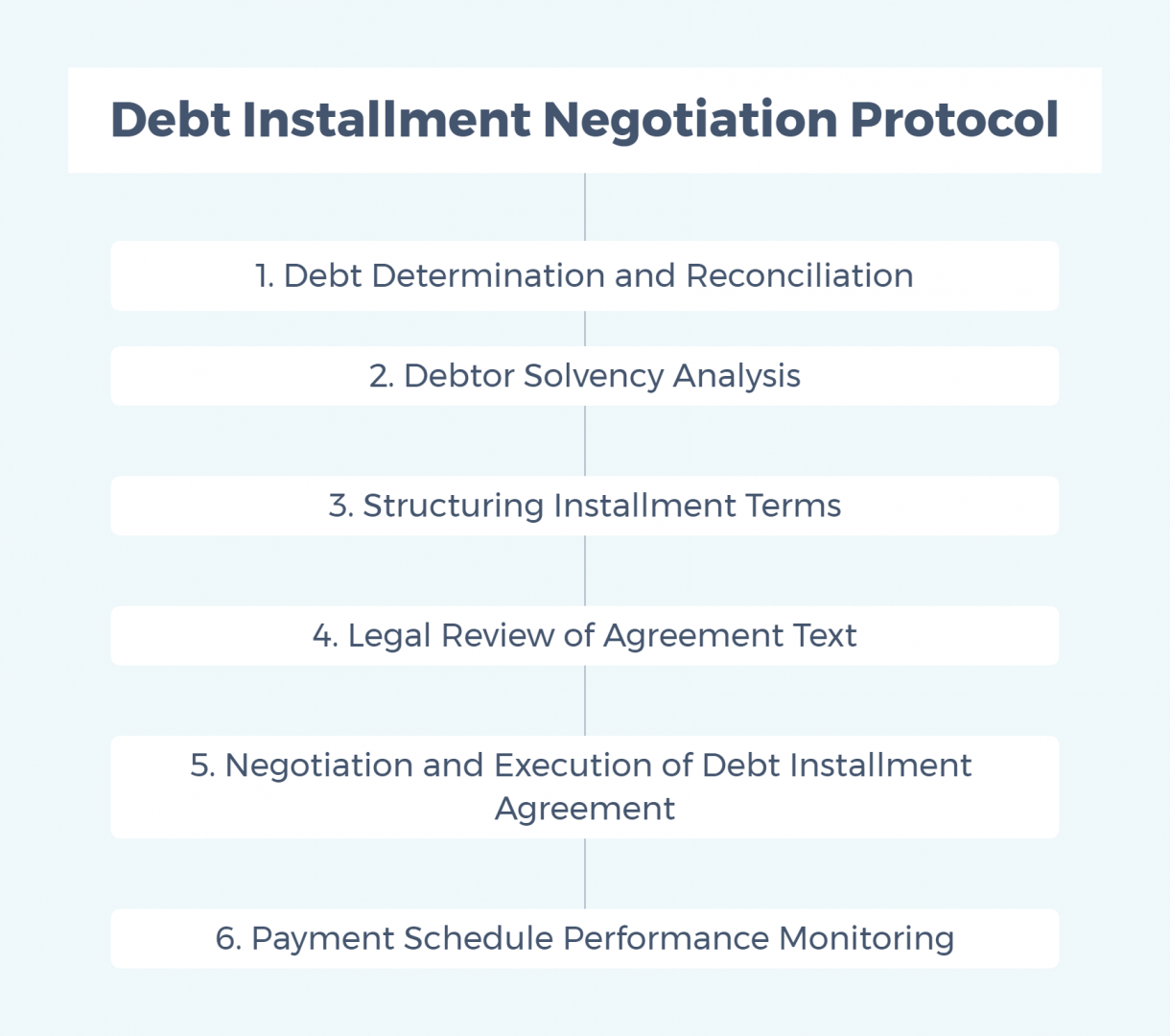
Executing a secure debt installment agreement involves a disciplined sequence of verification, negotiation, and formalization steps.
- calculating and reconciling the precise debt balance separating principal, interest, and penalties against primary contract documents and reconciliation acts;
- performing a rigorous financial and cash flow analysis to verify the debtor's capacity to service the proposed schedule without violating other operational obligations;
- negotiating core structural elements including installment duration, collateral requirements, interest regimes, and acceleration triggers;
- conducting legal due diligence to screen against bankruptcy clawback risks, tax liabilities, and potential conflicts with existing covenants;
- finalizing and executing the agreement in proper written form utilizing electronic signatures or notarization where mandated by security arrangements.
Navigating Legal and Regulatory Risks in Debt Restructuring
Drafting and executing debt installment agreements demands rigorous legal precision to protect creditor recovery rights while ensuring debtor compliance under Russian commercial law. Flawed documentation, ambiguous payment schedules, or inadequate collateral provisions can transform an attempted settlement into a protracted litigation hazard. Our legal team provides comprehensive representation for international investors, corporate creditors, and business entities across Russia, managing debt restructuring negotiations, risk audits, and commercial arbitration disputes. To protect your commercial interests and secure enforceable debt recovery, contact our legal experts through our website or direct consultation channels.
FAQ
What mandatory provisions must be included in an enforceable payment schedule?
Are installment agreements vulnerable to challenge in a debtor's subsequent bankruptcy?
What happens if a debtor misses a single payment under an installment schedule?
Does signing an installment agreement reset the statute of limitations?
Can an installment agreement be combined with a novation of the original debt?

Key Terms
B
Bankruptcy (Insolvency)
C
Contractual Penalty
I
Installment Debt (Debt with Installment Payment)
P
Pre-Trial Dispute Resolution (Settlement)
R
Recovery / Debt Collection
S
Settlement Agreement
S
Surety / Guaranty (Poruchitelstvo)
Related articles
All articles
Debt Installment Agreements in Russia
Debt installment agreements serve as an effective mechanism to restructure and resolve commercial payment defaults without initiating immediate litigation. However, the commercial and legal efficacy of an installment arrangement depends entirely on its precise structural engineering—specifically how the terms are drafted to prevent evidentiary gaps, tax exposure, and bankruptcy clawback risks. For international investors, corporate executives, and creditors navigating cross-border or local Russian trade obligations, utilizing a legally robust installment framework ensures enforceable debt recovery while mitigating severe default exposures.

When Debt is Recognized as Bad Debt
Bad debt is recognized as debt for which there are no legal or factual opportunities for collection. Such debt is excluded from accounting records and, subject to established conditions, is reflected in the tax base as an expense (in the case of accounts receivable) or income (in the case of accounts payable).

Statute of Limitations for Debt Collection
The statute of limitations is a legally established period during which a creditor (a company or a citizen) can demand debt repayment through a court. As a general rule, this period is three years (the general statute of limitations). Upon expiration of this period, the borrower has the right to object to the collection, and the court will dismiss the debt collection lawsuit. However, it is crucial to understand that the expiration of the statute of limitations alone does not automatically release the debtor from the debt — the obligation continues to exist; it is simply its compulsory enforcement that becomes difficult.
Related services
Все услуги
Intellectual Property Law
Civil Law
Competition Law
Registration of legal entities
Legal support
Court Representation
Russia
Worldwide
Registration of a Company Name and Logo
Civil Law
Law of Obligations
Procedural Law
Legal support
Tax planning
Russia
The enforcement stage of debt recovery is the phase where a court decision is transformed into real payouts. KDpartners lawyers secure the initiation of enforcement proceedings, monitor the work of bailiffs, and apply compulsory enforcement measures until the debt is fully repaid.
Enforcement proceedings for debt recovery under a service agreement
Civil Law
Law of Obligations
Procedural Law
Court Representation
Legal support
Russia
A lawsuit for debt recovery is filed when the customer has not paid for the rendered services on time. To apply to a court, it is necessary to confirm the fact of performance of obligations and the sending of a pre-trial claim. KDpartners lawyers prepare a well-grounded lawsuit and achieve the recovery of the debt, interest, and court costs.
Lawsuit for debt recovery under a service agreement
Contact us
Leave a request and our lawyers will contact you as soon as possible to provide a free consultation on your issue.
