Date:
21.10.2026
Reading time:
10 minutes
Author:

Daniil Kadyrov
Managing Partner
When Debt is Recognized as Bad Debt
Date:
21.10.2026
Reading time:
10 minutes

Bad debt is recognized as debt for which there are no legal or factual opportunities for collection. Such debt is excluded from accounting records and, subject to established conditions, is reflected in the tax base as an expense (in the case of accounts receivable) or income (in the case of accounts payable).
Recognizing debt as bad allows a company to:
- correctly reflect assets and liabilities in financial statements;
- minimize tax risks and claims during audits;
- timely identify problematic settlements and reduce the burden on management accounting.
It is important to note that the fact of uncollectibility must be documented. The mere fact of a long delay in payment is not a sufficient ground for excluding a debt from accounting records. Recognizing a debt as bad is the result of a formal procedure based on specific legal grounds established in tax legislation.
Grounds for Recognizing Debt as Bad Debt
The procedure for recognizing debt as bad is established in Paragraph 2 of Article 266 of the Tax Code of the Russian Federation (TC RF). The law establishes an exhaustive list of grounds under which a debt can be excluded from records and, depending on the situation, taken into account as expenses or income.
|
Ground |
Documented Confirmation |
Commentary |
|
Expiration of the statute of limitations |
Inventory report, calculation of the period, legal opinion |
Applied by default (3 years), interruptions/suspensions are possible |
|
Liquidation of a legal entity |
Extract from the USRLE |
Exclusion without succession |
|
Death of an individual |
Death certificate, notary certificate |
In the absence of heirs or refusal of inheritance |
|
Termination of or refusal to initiate enforcement proceedings |
Decree of the FSSP |
Based on Art. 46 of Federal Law No. 229 |
|
Court's refusal to satisfy the claim |
Court decision that has entered into force |
When further appeal is impossible |
|
Other cases confirmed by documents |
Inventory report, correspondence, internal opinions |
Require justification |
Statute of Limitations as a Ground
The expiration of the statute of limitations is one of the most common grounds for recognizing debt as bad debt. It is a legal tool that protects the debtor from unreasonably long-standing claims and encourages the creditor to initiate collection in a timely manner.
According to Article 196 of the Civil Code of the Russian Federation (CC RF), the general statute of limitations is three years. It applies by default unless otherwise established by law or contract. The period is counted from the date when the creditor learned or should have learned about the violation of their right (Art. 200 of the CC RF). In relation to obligations with an established performance period, it starts from the date of default.
Example:
If payment under a contract was due on March 10, 2020, but was not received, the limitation period will begin on March 11, 2020, and will expire on March 11, 2023. After this period, the debt can be recognized as bad.
The limitation period can be interrupted, for example, if the debtor recognizes the debt in full or in part (payment, signed reconciliation report, letter requesting installment payments). In this case, the three-year period begins to be counted anew.
Also, the running of the period may be suspended, in particular:
- in case of force majeure;
- during the period of consideration of the case in a pre-trial procedure (if this is a mandatory stage);
- upon the introduction of a moratorium or other restrictions on collection.
After the grounds are removed, the period continues from the point where it stopped.
Documented Confirmation of the Impossibility of Collection
Recognizing debt as bad is possible if there are documents confirming the impossibility of its collection. This requirement is equally important both for financial reporting and for tax control purposes.
Documents are selected depending on the ground:
Upon expiration of the statute of limitations:
- inventory report of settlements;
- calculation of the start and end dates of the period;
- legal opinion or internal memorandum.
Upon liquidation of the debtor legal entity:
- extract from the Unified State Register of Legal Entities (USRLE) with a note on liquidation;
- if necessary — confirmation of the completion of bankruptcy proceedings.
Upon the death of the debtor individual:
- death certificate;
- certificate from the notary chamber on the absence of heirs or refusal of inheritance;
- court ruling confirming the impossibility of legal succession.
Upon termination of or refusal to initiate enforcement proceedings:
- decree of the Federal Bailiff Service (FSSP) on termination of proceedings under Paragraph 4 of Part 1 of Article 46 of Federal Law No. 229;
- decree of refusal to initiate enforcement proceedings (EP).
In the presence of a court decision:
- court ruling on the refusal of the claim;
- confirmation of the decision entering into legal force.
In the presence of other circumstances:
- inventory report with attached justifications;
- correspondence with the debtor;
- internal analytical documents confirming the impossibility of collection.
All documents must be properly executed, contain details, a date, and signatures. During a tax audit, they are subject to mandatory presentation upon request.
Procedure for Writing Off Debt in Accounting and Tax Tracking
Writing off debt recognized as bad is carried out according to the established rules of accounting and tax tracking. The procedure depends on the nature of the debt — accounts receivable or accounts payable — and on the presence of formed reserves.
On Accounts Receivable
If an organization creates a reserve for doubtful debts, bad accounts receivable are written off against this reserve. Otherwise, the write-off amount is not included in tax expenses.
The following entries are made in the accounts:
- Dr 63 Cr 62 — creation of a reserve for doubtful debts;
- Dr 91.2 Cr 63 — write-off against the reserve;
- or Dr 91.2 Cr 62 — if the write-off is made without using a reserve (outside of tax expenses).
On Accounts Payable
If within three years from the date of the deadline for performing the obligation the counterparty has not presented claims, such debt is subject to write-off with the allocation of the amount to other income.
Entry: Dr 60 (or 76, 62) Cr 91.1 — recognition of income from the write-off of accounts payable.
Tax Consequences:
- accounts receivable are taken into account in expenses if written off against a previously created reserve;
- accounts payable are included in non-operating income upon expiration of the statute of limitations;
- If the write-off is performed without supporting documents or outside the framework of established grounds, during an audit the tax authority has the right to assess additional corporate income tax and charge penalties.
Documentation:
- inventory report of settlements;
- accounting statement or memorandum;
- documents confirming the impossibility of collection.
All actions must be fixed in the accounting policy and internal regulations of the company.
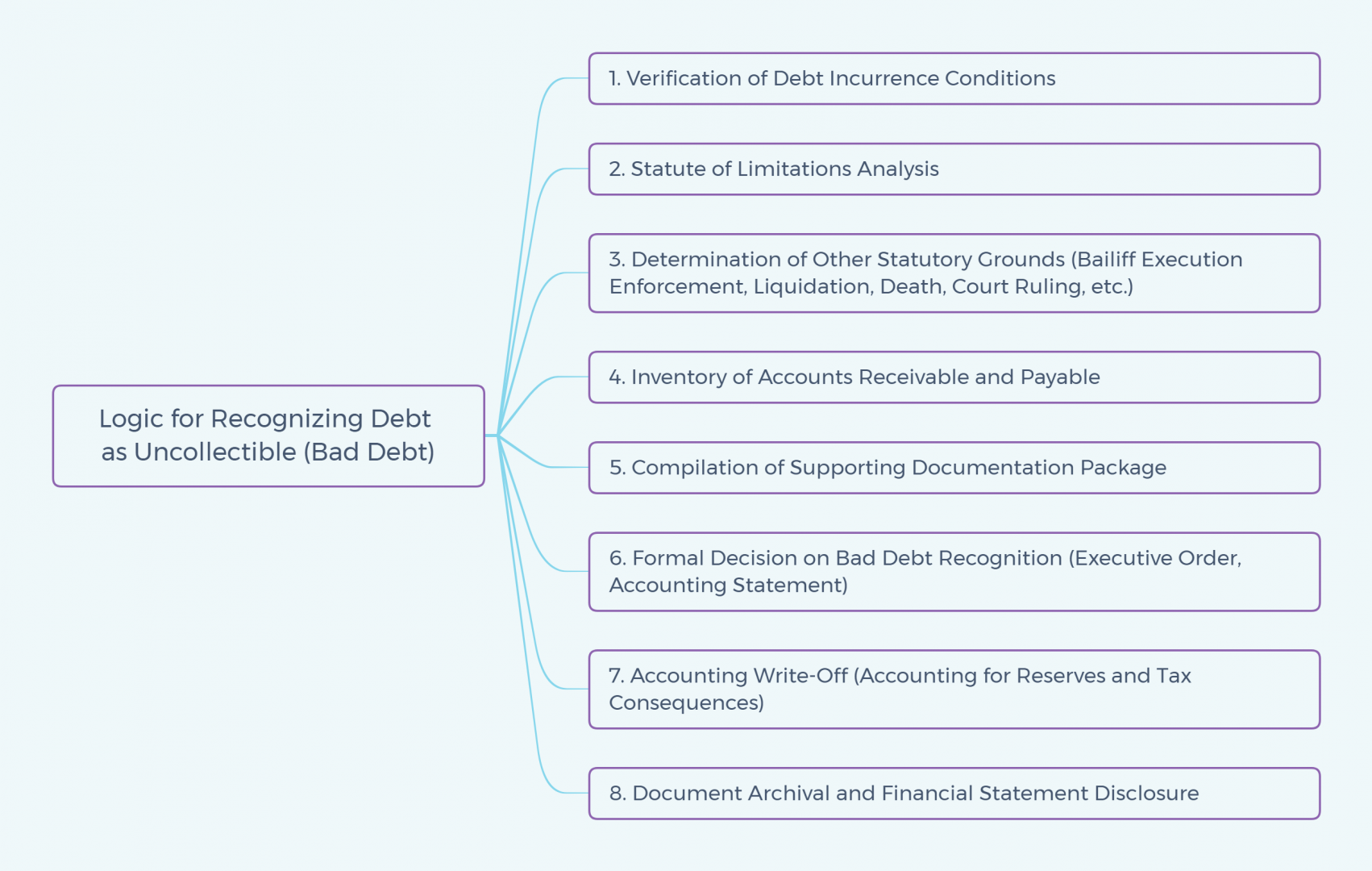
Conclusions and Recommendations
Bad debt is a sign of the impossibility of further collection, fixed in the legal and financial dimensions. The grounds for its recognition are strictly defined by law. Their application requires accurate qualification and supporting documents, especially in the case of tax control.
The company should take into account the following:
- the application of grounds from Article 266 of the TC RF is possible only if there is a proper documentary base;
- writing off accounts receivable in tax expenses is permissible provided that a reserve is created;
- accounts payable are recognized as income upon expiration of the period for presenting claims;
- an inventory report, statements, and extracts from registers, decrees of the FSSP, and judicial acts are key documents when justifying the impossibility of collection;
- inclusion of bad debt in reporting without formal grounds may entail additional tax assessments.
The impossibility of collection is a legal fact that must be properly qualified and confirmed. If you need support in this matter, contact the specialists of KDpartners at the specified phone number or through the form on the website.
FAQ
How to reflect the write-off of bad debt in accounting and tax tracking?
Can debt be recognized as bad if enforcement proceedings ended without result?
What documents need to be prepared when writing off bad debt in accounting?
How is the impossibility of collecting debt confirmed upon expiration of the statute of limitations?
Is overdue debt automatically considered bad debt?
In what cases can debt be recognized as bad debt under current legislation?

Key Terms
A
Accounts Receivable (Receivables)
B
Bankruptcy (Insolvency)
D
Debt
D
Debtor
E
Enforcement Proceedings
L
Limitation Period (Statute of Limitations)
W
Writ of Execution
Related articles
All articles
When Debt is Recognized as Bad Debt
Bad debt is recognized as debt for which there are no legal or factual opportunities for collection. Such debt is excluded from accounting records and, subject to established conditions, is reflected in the tax base as an expense (in the case of accounts receivable) or income (in the case of accounts payable).

Statute of Limitations for Debt Collection
The statute of limitations is a legally established period during which a creditor (a company or a citizen) can demand debt repayment through a court. As a general rule, this period is three years (the general statute of limitations). Upon expiration of this period, the borrower has the right to object to the collection, and the court will dismiss the debt collection lawsuit. However, it is crucial to understand that the expiration of the statute of limitations alone does not automatically release the debtor from the debt — the obligation continues to exist; it is simply its compulsory enforcement that becomes difficult.

Russian Tax Liabilities, Audit Risks, and Criminal Exposure for Foreign-Owned Companies and Directors
Foreign corporations, international investors, and non-resident executives operating subsidiaries or commercial branches in the Russian Federation face heightened scrutiny from the Federal Tax Service (FTS) and enforcement authorities. Russia’s tax administration relies on automated digital monitoring systems—including cross-border transaction tracking and unified tax accounting—making compliance failures costly. Unpaid tax liabilities exceeding RUB 18.75 million trigger mandatory criminal referrals under Article 199 of the Russian Criminal Code, exposing company executives and beneficial owners to personal liability, asset freezing, and criminal prosecution.
Related services
Все услуги
Intellectual Property Law
Civil Law
Competition Law
Registration of legal entities
Legal support
Court Representation
Russia
Worldwide
Registration of a Company Name and Logo
Civil Law
Law of Obligations
Procedural Law
Legal support
Tax planning
Russia
The enforcement stage of debt recovery is the phase where a court decision is transformed into real payouts. KDpartners lawyers secure the initiation of enforcement proceedings, monitor the work of bailiffs, and apply compulsory enforcement measures until the debt is fully repaid.
Enforcement proceedings for debt recovery under a service agreement
Civil Law
Law of Obligations
Procedural Law
Court Representation
Legal support
Russia
A lawsuit for debt recovery is filed when the customer has not paid for the rendered services on time. To apply to a court, it is necessary to confirm the fact of performance of obligations and the sending of a pre-trial claim. KDpartners lawyers prepare a well-grounded lawsuit and achieve the recovery of the debt, interest, and court costs.
Lawsuit for debt recovery under a service agreement
Contact us
Leave a request and our lawyers will contact you as soon as possible to provide a free consultation on your issue.
