Date:
19.11.2026
Reading time:
9 minutes
Author:

Daniil Kadyrov
Managing Partner
How to Register a Joint-Stock Company in Russia
Date:
19.11.2026
Reading time:
9 minutes

Article
Introduction Overview of the Joint-Stock Company Registration Process Public vs. Non-Public Joint-Stock Companies Statutory Requirements and Sanctions Compliance Engaging a Licensed Share Registrar Before Filing Preparing Incorporation Documents Filing with the Tax Authority and Registering the Share Issue Opening a Corporate Bank Account Navigating Legal and Regulatory Risks in Joint-Stock StructuringRegistering a joint-stock company in Russia takes three business days at the tax registration authority once filings are submitted—with zero state duty for electronic applications and a 4,000-ruble fee for paper submissions—while initial share issues must be registered within 30 days of state registration and minimum authorized capital starts at 10,000 rubles for non-public companies and 100,000 rubles for public companies. Although overall entity formation in Russia declined by nearly 20% over 2025, mid-sized and large businesses—including international and cross-border groups—continue to use joint-stock companies for structured corporate governance, private investment rounds, and alignment with evolving securities registrar rules and digital ruble settlement infrastructure. This guide covers public versus non-public company structures, pre-filing share registrar engagement, incorporation steps, initial share issuance, bank onboarding, and compliance in Russia.
Overview of the Joint-Stock Company Registration Process
Establishing a joint-stock company in Russia follows six core stages:
- selecting the appropriate corporate form between a public and a non-public joint-stock company;
- executing a shareholder register maintenance agreement with a licensed registrar;
- preparing the foundational and registration document package;
- filing the state registration application with the tax authority;
- registering the initial share issue with the Central Bank of Russia or an authorized registrar;
- opening a corporate bank account and completing compliance screening.
Public vs. Non-Public Joint-Stock Companies
Choosing between a public joint-stock company and a non-public joint-stock company determines capital thresholds, share transfer rules, disclosure obligations, and governance flexibility.
|
Feature |
Public Joint-Stock Company |
Non-Public Joint-Stock Company |
|
share placement |
public placement, including open exchange subscription |
restricted to a predetermined circle of persons |
|
minimum authorized capital |
100,000 rubles |
10,000 rubles |
|
shareholder disclosure |
public disclosure and mandatory reporting |
entries in shareholder register with potential ownership privacy |
|
share transfers |
free transferability without statutory pre-emption restrictions |
optional pre-emptive purchase rights for existing shareholders |
|
governing bodies |
mandatory board of directors or supervisory council |
option for streamlined management structure |
Non-public joint-stock companies suit closely held investments and structured corporate control where share transfers can be regulated in the charter, whereas public joint-stock companies fit open capital markets and exchange listings.
Statutory Requirements and Sanctions Compliance
Before initiating incorporation, founders must confirm that the entity meets baseline statutory and regulatory conditions:
- one or more founders consisting of individuals or legal entities, noting that a joint-stock company cannot have another single-member company as its sole shareholder;
- a full and abbreviated corporate name in Russian identifying the joint-stock form;
- minimum authorized capital of at least 10,000 rubles for a non-public company or 100,000 rubles for a public company;
- a verified non-residential registered legal address in Russia;
- appointment of a sole executive body such as a general director.
Where foreign founders or cross-border capital structures are involved, compliance also requires verifying jurisdictional rules, counter-sanctions restrictions, beneficial ownership transparency, and bank Know Your Customer and anti-money laundering standards before committing funds.
Engaging a Licensed Share Registrar Before Filing
Unlike a limited liability company where equity ownership is recorded in the state corporate register, a joint-stock company cannot maintain its own shareholder register and must contract with a licensed securities registrar before filing for state registration.
To set up register maintenance prior to incorporation, applicants must:
- select a registrar from the list of licensed securities market participants;
- execute a contract for maintaining and storing the shareholder register;
- obtain written confirmation or a certificate from the registrar confirming contract execution.
Details of the registrar are entered into the Unified State Register of Legal Entities alongside incorporation, so omitting prior registrar engagement risks outright tax registration refusal. Under Central Bank rules effective January 2, 2026 governing document provision to shareholders, and expanded registrar functions in 2026 acting as intermediaries in initial share issues, early coordination with the registrar streamlines both governance and primary issuance.
Preparing Incorporation Documents
Once the registrar contract is in place, founders assemble the legal documents governing the company's creation and operations:
- the company charter defining governance rules, shareholder rights, and authority of corporate bodies;
- a sole founder's incorporation decision or minutes of the founders' general meeting for multiple founders;
- a founding agreement regulating joint actions of two or more founders during setup;
- state registration application Form R11001 specifying the registered address, general director, and registrar;
- proof of state duty payment when filing paper documents.
For foreign participants, personal and corporate identifiers in resolutions and the charter must match notarized Russian translations accurately to avoid filing rejections.
Filing with the Tax Authority and Registering the Share Issue
State registration is filed with the tax inspectorate for the company's registered address. Electronic filing via a qualified electronic signature requires no state duty and avoids notary fees for signature certification, whereas paper submissions via a representative, mail, or multifunctional center require notarization of the applicant's signature on Form R11001 and a 4,000-ruble state duty. Tax registration takes three business days, delivering an electronic extract from the Unified State Register of Legal Entities and a marked charter.
Incorporation creates the legal entity, while registering the initial share issue—required within 30 days of entry into the Unified State Register of Legal Entities—legitimizes the shares themselves through the Central Bank of Russia or an authorized registrar. Once the issue receives a state registration or identification number, shares are credited to founders' personal accounts in the registrar's system, and legal dispositions such as sales or pledges become possible.
Opening a Corporate Bank Account
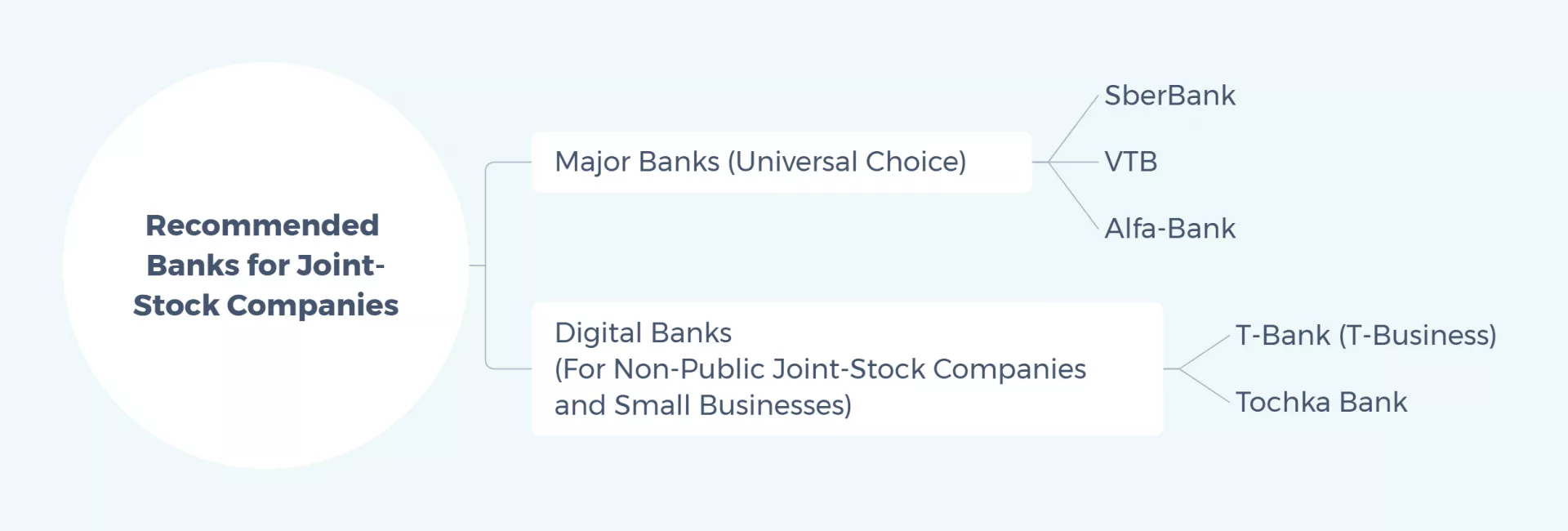
Opening a settlement account requires submitting corporate records, the state register extract, the director appointment order, and premises title or lease documents, alongside bank security checks on founder reputation, beneficial ownership, source of funds, and actual business operations. With major financial institutions integrating digital ruble capabilities by September 2026 alongside existing ruble and cross-border payment channels, completing account onboarding enables salary payments, capital contributions, and commercial settlements.
Navigating Legal and Regulatory Risks in Joint-Stock Structuring
Registering a joint-stock company in Russia demands strict sequencing across registrar contracting, charter drafting, 30-day share issue filings, and banking compliance, particularly where foreign ownership, cross-border settlements, or counter-sanctions rules apply. Errors in document consistency, registrar coordination, or filing deadlines can result in registration refusals, administrative penalties, or delayed share transferability. To structure a joint-stock company or manage regulatory and banking compliance in Russia, consult the corporate legal specialists at KDpartners.
FAQ
What happens if share issue documents are not filed within 30 days of registration?
Is a state duty payable when filing joint-stock company registration documents electronically?
What is the minimum authorized capital for a non-public joint-stock company in 2026?
Must a joint-stock company hire a registrar if it has only two shareholders?
What is the difference between registering a joint-stock company and registering its share issue?
Can one person be the sole founder and shareholder of a joint-stock company?

Key Terms
A
Articles of Association (Charters / Bylaws)
A
Authorized Capital
C
Corporate Status (Lex Societatis)
F
Federal Tax Service (FNS of Russia)
I
Interregional Inspectorate of the Federal Tax Service of Russia for Largest Taxpayers
K
Know Your Customer (KYC)
M
Mandatory Reserve Requirements (Central Bank)
S
State Duty
Related articles
All articles

How to Open a Branch of a Foreign Company in Russia
Opening a branch of a foreign company in Russia requires completing state accreditation—which takes 15 business days at the tax registration authority after Chamber of Commerce headcount certification and carries a 120,000-ruble state fee—while operating under the general tax system with a 25% corporate profits tax rate and a 22% standard value-added tax rate effective January 1, 2026. Because a branch is not a separate legal entity, it simplifies asset oversight inside the foreign corporate group while leaving the parent entity fully liable for its obligations and subject to heightened scrutiny over jurisdiction status, beneficial ownership, counter-sanctions rules, and banking compliance. This guide details the step-by-step branch setup process, document legalization, headcount approvals, tax accreditation, social and statistical registration, banking onboarding, and ongoing obligations in Russia.
How to Register a Joint-Stock Company in Russia
Registering a joint-stock company in Russia takes three business days at the tax registration authority once filings are submitted—with zero state duty for electronic applications and a 4,000-ruble fee for paper submissions—while initial share issues must be registered within 30 days of state registration and minimum authorized capital starts at 10,000 rubles for non-public companies and 100,000 rubles for public companies. Although overall entity formation in Russia declined by nearly 20% over 2025, mid-sized and large businesses—including international and cross-border groups—continue to use joint-stock companies for structured corporate governance, private investment rounds, and alignment with evolving securities registrar rules and digital ruble settlement infrastructure. This guide covers public versus non-public company structures, pre-filing share registrar engagement, incorporation steps, initial share issuance, bank onboarding, and compliance in Russia.

How to Open a Company in Russia Remotely
Registering a company in Russia remotely takes three business days at the tax registration authority once filings are submitted—with zero state duty for electronic applications—while estimated remote launch costs typically span RUB 20,000 to RUB 45,000 excluding specialized legal fees and corporate banking onboarding requires strict Know Your Customer and currency control verification. Foreign citizens and international founders can complete incorporation either through an authorized representative acting under a power of attorney or via qualified electronic signatures without traveling to Russia for the registration filing itself. This guide details remote incorporation channels, registered address verification, tax registration updates, corporate bank account onboarding, and tax compliance for foreign founders in Russia.
Contact us
Leave a request and our lawyers will contact you as soon as possible to provide a free consultation on your issue.
