Date:
21.11.2026
Reading time:
9 minutes
Author:

Daniil Kadyrov
Managing Partner
Cross-Border Payment Compliance Checklist for Companies
Date:
21.11.2026
Reading time:
9 minutes

Article
Introduction 1. Screen the Counterparty, Beneficial Owners, and Logistics Chain 2. Match Harmonized System Codes Against Sanctions Lists 3. Synchronize Contract and Payment Documentation 4. Audit Payment Agent Structures and Routing 5. Prepare Russian Currency Control and Anti-Money Laundering Documentation Comparison of Settlement Channels and Compliance Risks Common Errors That Trap Funds Abroad Navigating Legal and Regulatory Risks in Cross-Border SettlementsPre-payment compliance screening can filter out up to 90% of cross-border settlement risks before a transfer is initiated, helping companies avoid frozen correspondent funds, three-to-six-week payment returns with intermediary fee deductions, and currency control or anti-money laundering disputes in Russia. In 2026, secondary compliance screening by foreign banks and payment institutions—driven by sanctions and counter-sanctions exposure, Know Your Customer and anti-money laundering controls, and currency regulation—affects settlements even with China, the United Arab Emirates, Türkiye, the Commonwealth of Independent States, and Southeast Asia. This guide sets out a five-step pre-payment compliance checklist, compares settlement mechanisms and risk profiles, identifies recurring operational failures, and answers common cross-border payment questions.
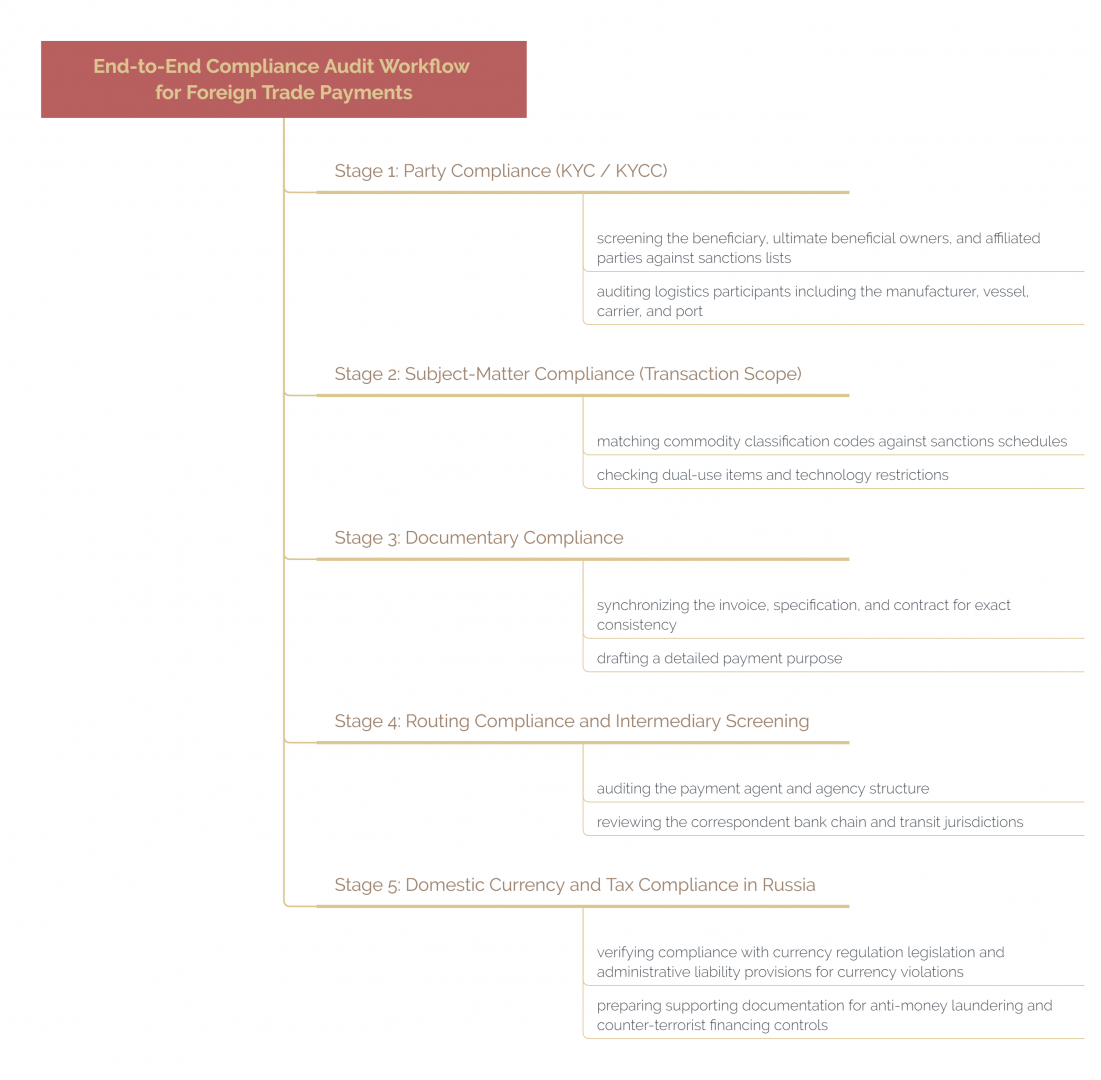
Five-Step Pre-Payment Compliance Checklist
1. Screen the Counterparty, Beneficial Owners, and Logistics Chain
Screening only the nominal recipient does not prevent payment holds because automated bank filters apply the 50% ownership rule—treating an entity as subject to sanctions if 50% or more of its assets or ownership are held by sanctioned persons—and flag sanctioned vessels, carriers, or transit ports.
To address counterparty and logistics exposure before sending funds:
- review ownership up to ultimate beneficial owners to confirm no sanctioned individuals or entities hold stakes in the counterparty;
- check the chief executive officer and board members against current sanctions lists;
- audit the full logistics chain—including the original equipment manufacturer, vessel owner, vessel identification number, charterer, and transit ports—for restricted parties or facilities.
2. Match Harmonized System Codes Against Sanctions Lists
Automated compliance filters routinely screen Harmonized System commodity codes against sanctions schedules and dual-use or high-technology restrictions, halting transfers for technical clarification when a code matches restricted goods.
To verify the transaction subject matter:
- check the first six digits of the Harmonized System code across international classifications, as domestic and destination or transit classifications can diverge;
- screen the code against dual-use, industrial equipment, and microelectronics control lists;
- align goods descriptions across trade documents with standard Harmonized System wording and avoid ambiguous or overly specialized technical labels that filters may read as restricted equipment.
3. Synchronize Contract and Payment Documentation
Minor discrepancies across contracts, specifications, invoices, and payment instructions frequently trigger manual compliance reviews that add weeks to processing and raise cancellation risk.
To align payment and contract records:
- match legal names, addresses, bank details, and bank identifier codes character-for-character across all transaction documents;
- confirm the settlement currency against contract terms and fix cross-rates and conversion rules in writing for multi-currency deals;
- state a complete payment purpose containing contract and invoice references, exact goods or service descriptions, the Harmonized System code, value-added tax treatment, and a clear civil-use statement.
4. Audit Payment Agent Structures and Routing
Where direct transfers are unfeasible, payment agents and trading houses in third jurisdictions introduce bank rejection risks and tax qualification challenges in Russia if the intermediary arrangement is poorly documented.
When engaging a payment agent:
- perform Know Your Customer checks on incorporation history, jurisdiction, sanctions affiliation, and required licenses or authorizations;
- execute an agency agreement or tripartite assignment/obligation-change agreement specifying that the agent acts on the principal's instruction and account and that its payment discharges the obligation to the supplier;
- require closing deliverables including an agent report, bank payment confirmation from the final bank, and supplier receipt confirmation;
- define liability for intermediary bank fees and refund timelines if a transfer is returned or blocked.
5. Prepare Russian Currency Control and Anti-Money Laundering Documentation
Even transfers that clear foreign compliance can be blocked or penalized in Russia under currency regulation rules, anti-money laundering and counter-terrorist financing controls, and special economic measures.
To protect currency and tax compliance in Russia:
- verify compliance with Russian currency limits, presidential decrees, and timely registration of the unique contract number;
- prepare the contract, specifications, invoices, and logistics records for bank currency control;
- prepare a written economic rationale for bank financial monitoring explaining the commercial logic and fee structure of multi-step or agency routes.
Comparison of Settlement Channels and Compliance Risks
Risk exposure varies significantly across cross-border settlement routes depending on intermediary screening, currency control tracking, and evidentiary documentation.
|
Settlement Method |
Compliance Risk Level |
Primary Failure Points |
Core Documentation |
Risk Mitigation Measures |
|
direct bank transfer via non-sanctioned or regional banks |
high |
correspondent bank blocks or returns; automated code and ownership screening hits; unexplained fund holds |
cross-border contract, invoice, specification, civil-use undertaking, logistics papers |
request approved correspondent banks in advance; pre-screen commodity codes; include currency and route change clauses |
|
payment agent or trading house in third jurisdictions |
moderately high |
tax authority challenge to expense deductibility; bank compliance queries; agent refund delays |
agency or tripartite agreement, detailed agent fee report, final bank transfer proof, supplier reconciliation |
use tailored tripartite agreements; fix refund duties on blocks; align Russian tax and currency compliance |
|
promissory note, clearing, and offset arrangements |
critical |
currency regulation and anti-money laundering exposure; contract closure difficulties; tax and audit scrutiny |
assignment contracts, set-off agreements, full primary document chain across all parties |
use only when alternatives are unavailable; audit every link in the chain; clear structure with bank currency control in advance |
|
digital financial assets or crypto channels |
high due to statutory limits |
divergent legal classification; accounting and tax reporting complexity; exchange or wallet screening blocks |
information technology or financial service agreements, conversion reports, source-of-funds proof |
use only structures aligned with current Russian rules; verify wallet and transaction compliance history |
Common Errors That Trap Funds Abroad
Practical cross-border deal experience highlights three recurring mistakes that cause payment holds, fines, and commercial losses:
- using pre-crisis contract templates and formal invoices without bank-block force majeure clauses, backup currencies and routing options, or action rules for delays exceeding ten business days;
- concealing payment agent routes from Russian currency control or recipient banks instead of presenting a transparent tripartite structure showing who pays, on what basis, and for whose account;
- vetting only the trading counterparty while omitting checks on the actual manufacturer and transport chain, allowing a restricted factory or vessel in the packing list to trigger an automated correspondent bank block.
Navigating Legal and Regulatory Risks in Cross-Border Settlements
Reliable cross-border settlement depends less on bank processing speed than on rigorous pre-payment legal verification across counterparties, commodity codes, logistics chains, and contract terms. Where multi-step payment routes, agency structures, or sanctions and currency compliance rules create heightened exposure, engaging the legal specialists at KDpartners helps audit transaction risks and structure documentation before funds are sent.
FAQ
What liability does an authorized Russian bank bear when a foreign bank returns a payment?
Can a payment be blocked even when the direct seller is not under sanctions?
What are the consequences of structuring a payment agent arrangement improperly?
Are payment agents legal for cross-border settlements in 2026?
What should a company do if a foreign bank freezes a cross-border payment?

Key Terms
F
False Positives
F
Financial Intelligence (AML/CFT Monitoring)
O
OFAC 50 Percent Rule
R
Registry of Foreign Agents (Russia)
R
Reputational Risk in Sanctions
S
Sanctions Clause in Contracts
S
Sanctions Due Diligence
S
Sanctions Screening
S
SDN List (Specially Designated Nationals)
S
Secondary Sanctions
Related articles
All articles

E-Commerce Operations Between China and International Markets: Tax, Customs, Payment Compliance, and Dispute Protection
Cross-border e-commerce between China and international markets requires full customs declarations, jurisdiction-specific product compliance and labeling, and verifiable payment chains—where structured tax and customs planning preserves input tax recovery and prevents cargo holds, while informal shipping routes and unverified payment intermediaries expose foreign sellers and brands to inventory seizures, account freezes, and regulatory penalties. As online marketplaces and customs authorities tighten enforcement around cross-border trade, manufacturers, brand owners, and sellers moving goods from China into target jurisdictions face scrutiny over customs valuation, origin and product safety rules, cross-border fund repatriation, and marketplace enforcement. This guide sets out the core operating principles for China-to-international-market e-commerce, compares operating models, and addresses key customs, tax, payment, and marketplace dispute questions.

What to Do If a Bank Suspends Account Operations in Russia
When a bank suspends account operations or restricts remote banking access, responding within the statutory review window—where banks generally have up to seven business days to assess submitted explanations and central bank interdepartmental reviews take up to 20 business days—is essential to prevent account termination or high-risk classification. Financial institutions enforce anti-money laundering and counter-terrorist financing rules alongside central bank risk-scoring algorithms and automated client-risk platform checks, making accurate classification of the restriction the first step. This guide sets out a five-step response workflow, highlights actions that worsen compliance exposure, compares escalation channels, and answers core operational questions.

How to Open a Bank Account in Hong Kong for Foreign Companies
Opening a bank account in Hong Kong typically takes from one to three weeks through payment platforms, three to five weeks via virtual banks, or six to ten weeks at traditional banks, with minimum balance requirements ranging from zero to $50,000 depending on the institution. While Hong Kong remains a central trade and settlement hub for the Asia-Pacific region—supporting transactions in Chinese yuan, Hong Kong dollars, and United Arab Emirates dirhams—regulatory oversight by the Hong Kong Monetary Authority and banking compliance teams enforces strict enhanced due diligence on cross-border ownership structures, commercial substance, and fund provenance. This guide sets out a six-step account opening workflow for foreign companies, compares Hong Kong financial institutions, identifies common compliance failure points, and answers core operational and tax questions.
Contact us
Leave a request and our lawyers will contact you as soon as possible to provide a free consultation on your issue.
