Date:
21.11.2026
Reading time:
15 minutes
Author:

Daniil Kadyrov
Managing Partner
1961 Hague Apostille Convention: Cross-Border Document Legalization
Date:
21.11.2026
Reading time:
15 minutes
Article
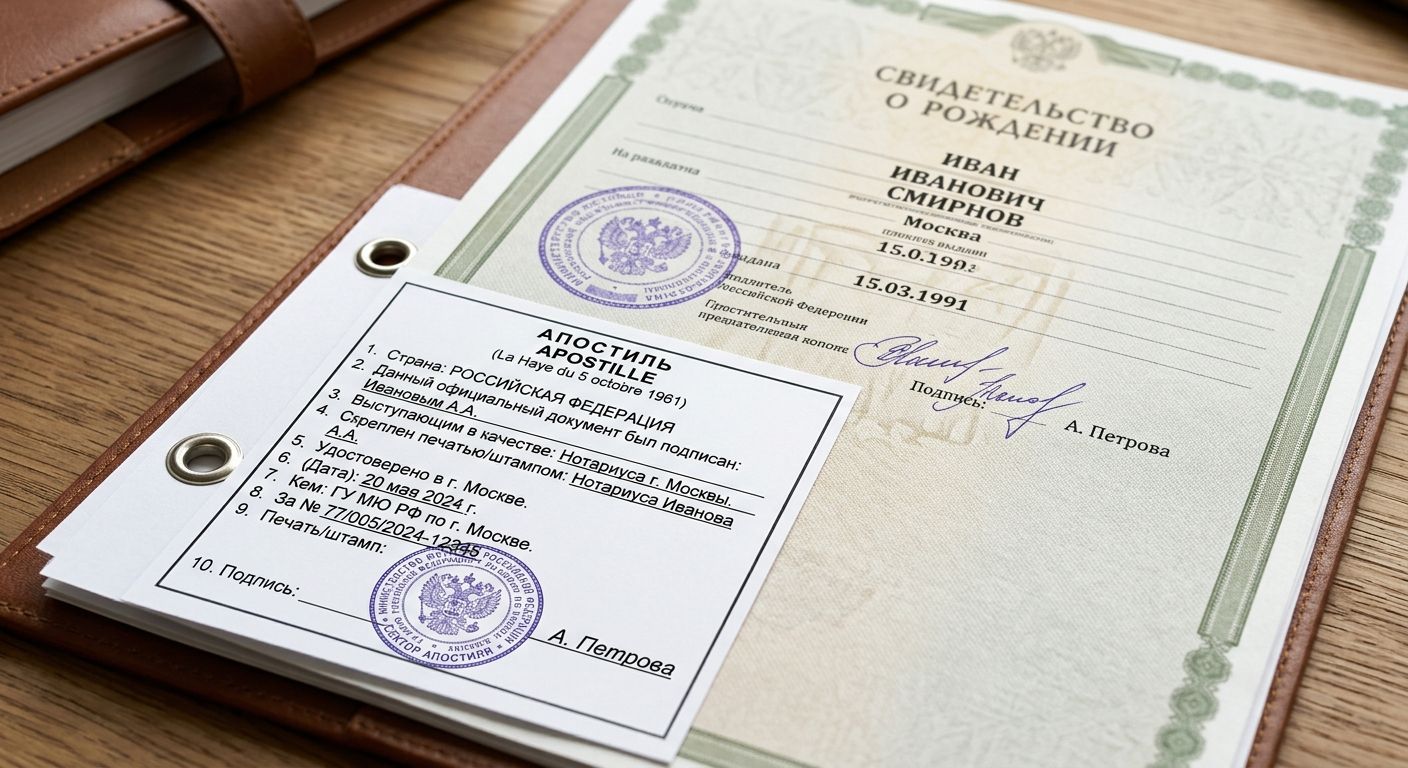
Introduction Apostille vs. Consular Legalization Eligible and Excluded Documents and Competent Authorities Structure and Legal Effect of the Apostille Stamp Validity Period of an Apostille Treaty Geography, Objections, and Compliance Context Contracting States and Territories of the 1961 Hague Apostille Convention Navigating Legal and Regulatory Risks in Cross-Border Document FlowsApostille certification under the 1961 Hague Apostille Convention replaces multi-step consular legalization with a single-window stamp—carrying a statutory fee of 2,500 rubles per document in Russia and applying in over 120 contracting states, including Russia since May 31, 1992 and mainland China since November 7, 2023. For international businesses, investors, and executives navigating cross-border corporate filings, bank account opening, or arbitration, properly authenticated official records avoid rejected filings, repeated legalization costs, and Know Your Customer or sanctions compliance delays. This guide explains apostille versus consular legalization, eligible and excluded documents, stamp structure, validity rules, treaty geography and objections, and practical legalization workflows.
Apostille vs. Consular Legalization
Authenticating an official document for cross-border use depends on confirming the authenticity of the signatory's signature, official capacity, and seal or stamp impression. Legal practice relies on two distinct authentication mechanisms: multi-stage consular legalization and simplified apostille certification.
Consular legalization applies to cross-border document flows with jurisdictions that have not joined the 1961 Hague Apostille Convention—such as the United Arab Emirates, Egypt, and Saudi Arabia—and operates strictly on a bilateral basis tied to a single destination country. Presenting the same official record in three non-convention jurisdictions requires repeating the legalization chain three separate times.
In the Russian Federation, consular legalization proceeds through four sequential stages:
- notarization of a copy of the document and the translator's signature;
- certification of the notary's signature and seal by the Ministry of Justice of the Russian Federation;
- verification of the Ministry of Justice seal by the Consular Department of the Ministry of Foreign Affairs of the Russian Federation;
- final authentication at the consulate or embassy of the destination country where the document will be submitted.
By contrast, the 1961 Hague Apostille Convention established a single-window apostille stamp issued by a competent authority in the state where the document originated, eliminating diplomatic middlemen between contracting states and enabling multi-jurisdiction use across convention members without repeating legalization in each destination country.
|
Comparison Criterion |
Apostille Certification |
Consular Legalization |
|
geographic scope |
recognized across contracting states of the 1961 convention, covering more than 120 jurisdictions |
valid only in the specific country whose consulate completed legalization |
|
procedural stages |
single-window authentication by the competent authority of the issuing state |
four stages involving notary, justice ministry, foreign ministry, and foreign consulate |
|
multi-country reusability |
reusable across convention states without re-legalizing the stamp, subject to local translation rules |
tied to one destination country and repeated separately for each non-member state |
|
competent authorities in Russia |
Ministry of Justice, civil registry offices, Ministry of Internal Affairs, education supervision authority, archival authorities, Prosecutor General's Office, and Ministry of Defense by document type |
notary, Ministry of Justice of the Russian Federation, Ministry of Foreign Affairs of the Russian Federation, and destination diplomatic mission |
Eligible and Excluded Documents and Competent Authorities
The 1961 convention applies solely to official documents executed in one contracting state that must be produced in another contracting state, and attempting to apostille non-covered instruments results in a lawful refusal by authorities.
Under Article 1 of the convention, official documents include:
- documents emanating from an authority or official connected with the courts or tribunals of the state, including public prosecutors, court clerks, and bailiffs such as judgments, rulings, sentences, and writs of execution;
- administrative documents such as criminal record certificates, archival extracts, and civil registry certificates covering birth, marriage, divorce, and death;
- notarial acts including powers of attorney, consents, wills, sale or gift agreements, and notarized copies or translations;
- official certifications such as registration endorsements, visas confirming a specific date, and signature authentications on instruments not originally notarized.
Conversely, Article 1 expressly excludes two categories of instruments:
- documents executed by diplomatic or consular agents, which cannot be apostilled;
- administrative documents dealing directly with commercial or customs operations, including invoices, international sale contracts, customs declarations, waybills, and certificates of origin.
In Russia, authority to affix an apostille is divided by document category and carries a statutory fee of 2,500 rubles per document under the Tax Code of the Russian Federation:
- the Ministry of Justice of the Russian Federation and its regional offices handle notarized copies, notarized translations, court acts, writs of execution, and records issued by regional authorities;
- civil registry offices apostille original certificates and records they issue on a territorial basis in the region where the record was registered;
- the Ministry of Internal Affairs and its information centers certify original criminal record and prosecution status certificates;
- the federal education supervision authority and regional education bodies certify original diplomas, school certificates, academic transcripts, and academic degree records, with federal register verification that can extend processing times;
- the federal archival agency and regional archives certify archival certificates, extracts, and copies issued by state or municipal archives;
- the Prosecutor General's Office and the Ministry of Defense of the Russian Federation certify documents issued within their respective institutional structures.
Structure and Legal Effect of the Apostille Stamp
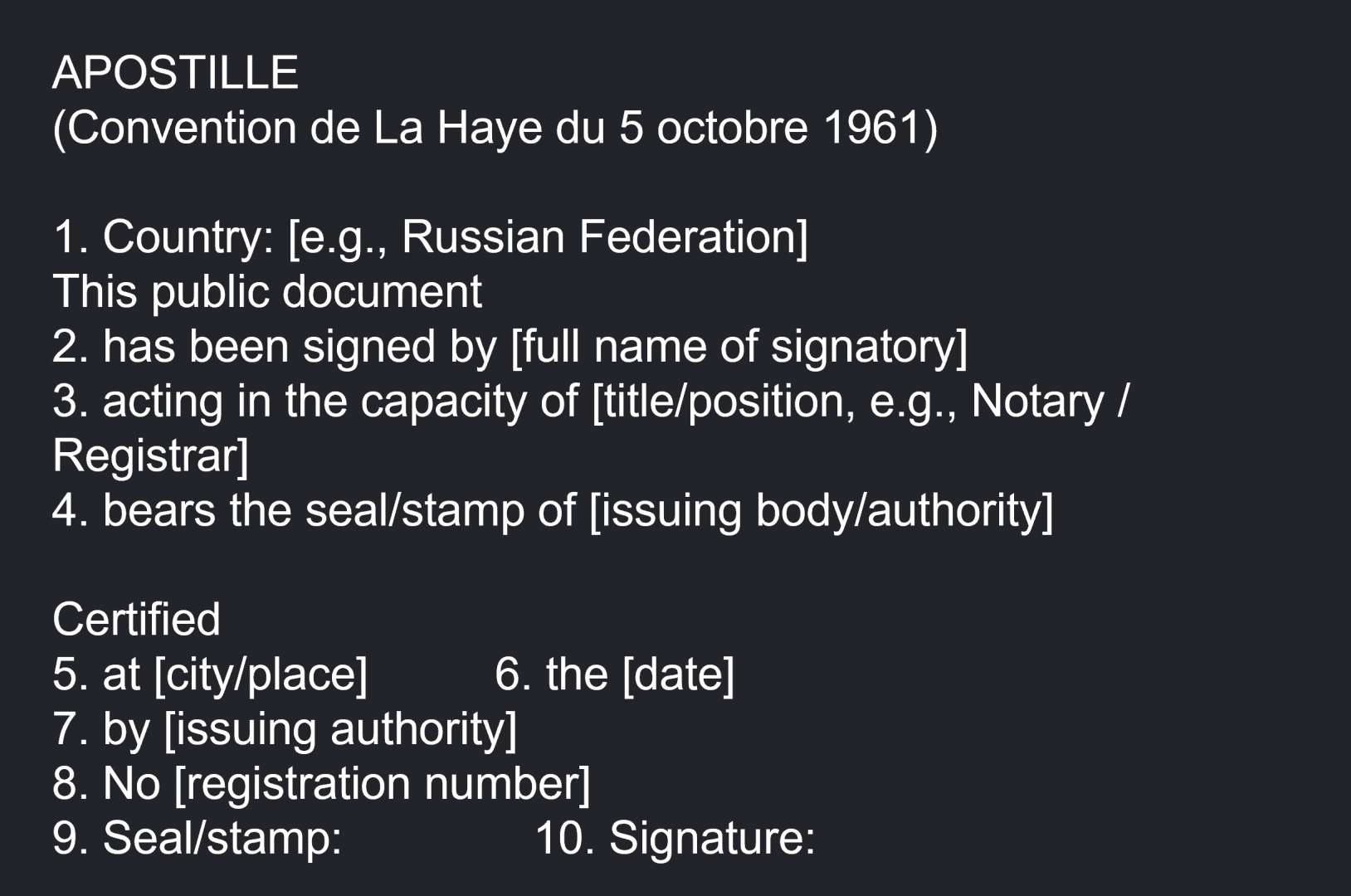
The format and contents of the apostille are standardized in the annex to the 1961 convention, and non-conforming stamps risk rejection by foreign courts and agencies. A compliant apostille must be a square at least nine centimeters wide, carry the mandatory French header reading Apostille (Convention de la Haye du 5 octobre 1961), include text in the issuing authority's official language—optionally duplicated in a second language such as English or French—and contain ten numbered items without altering, deleting, or adding fields.
The ten required fields follow a fixed sequence:
- country of issuance where the apostille is affixed;
- name of the person signing the underlying official document;
- capacity in which the person signing the underlying document acted;
- name of the authority whose seal or stamp the underlying document bears;
- place of certification where the apostille is executed;
- date of certification;
- authority issuing the apostille;
- number of the apostille in the authority's register;
- seal or stamp of the authority issuing the apostille;
- signature of the official executing the apostille.
The apostille certifies only the authenticity of the signature, the capacity of the signatory, and where appropriate the identity of the seal or stamp on the underlying document—not the substantive content of the underlying record—and requires no further diplomatic or notarized certification of the apostille itself, while its registration number and date can be verified against the issuing authority's records.
Validity Period of an Apostille
The apostille stamp itself has no statutory expiration date under the 1961 convention and remains valid for as long as the underlying document retains legal validity. In practice, usable duration depends on three factors:
- expiration of the underlying document itself, since criminal record certificates, commercial register extracts, marital status certificates, or non-bankruptcy certificates carry limited validity windows after which both the document and its apostille cease to be effective;
- recency rules set by receiving authorities, courts, banks, or visa centers, which frequently require extracts or certificates issued within the preceding three to six months;
- changes to registration details recorded in the underlying document, such as a notarized passport copy with an apostille that no longer reflects current registration data after an address change and requires a fresh copy and apostille.
Permanent civil status records and educational diplomas generally need apostilling once unless physically damaged or affected by personal data changes.
Treaty Geography, Objections, and Compliance Context
Full operation of the 1961 convention requires both the issuing state and the destination state to be parties according to the Hague Conference on Private International Law status table. Depending on bilateral and multilateral treaties, cross-border document flows from Russia follow three patterns:
- apostille certification applies with convention member states that do not have broader mutual legal assistance exemptions—such as the United States, the United Kingdom, Germany, Italy, France, Japan, the Republic of Korea, Canada, and Australia—requiring an apostille in Russia plus a certified translation into the target language;
- exemption from legalization applies where bilateral or multilateral treaties—such as the Minsk Convention across Commonwealth of Independent States members and treaties with countries including Bulgaria, Hungary, Vietnam, Cuba, Romania, and Czechia—dispense with apostilles and require only notarized translation;
- consular legalization applies with non-member states such as the United Arab Emirates, Saudi Arabia, Egypt, and Iraq, whereas mainland China became a contracting state effective November 7, 2023.
Under Article 12 of the convention, an existing contracting state may object to a new state's accession within six months of notification, preventing the convention from entering into force between those two specific states and leaving consular legalization in place between them. For foreign companies opening bank accounts or structuring investments in Russia—or Russian companies operating abroad—document authentication also intersects with bank Know Your Customer and anti-money laundering checks, beneficial ownership disclosure, sanctions screening, and counter-sanctions or currency control compliance.
Contracting States and Territories of the 1961 Hague Apostille Convention
|
Letter |
Countries and Territories |
|
A |
Albania, Andorra, Antigua and Barbuda, Argentina, Armenia, Australia, Austria, Azerbaijan |
|
B |
Bahamas, Bahrain, Bangladesh, Barbados, Belarus, Belgium, Belize, Bolivia, Bosnia and Herzegovina, Botswana, Brazil, Brunei Darussalam, Bulgaria, Burundi |
|
C |
Cabo Verde, Canada, Chile, China (including Mainland China, Hong Kong, and Macao), Colombia, Cook Islands, Costa Rica, Croatia, Cyprus, Czechia |
|
D |
Denmark (excluding Greenland and the Faroe Islands), Dominica, Dominican Republic |
|
E |
Ecuador, El Salvador, Estonia |
|
F |
Fiji, Finland, France |
|
G |
Georgia, Germany, Greece, Grenada, Guatemala, Guyana |
|
H |
Honduras, Hungary |
|
I |
Iceland, India, Indonesia, Ireland, Israel, Italy |
|
J |
Jamaica (if applicable per current status), Japan |
|
K |
Kazakhstan, Kosovo, Kyrgyzstan |
|
L |
Latvia, Lesotho, Liberia, Liechtenstein, Lithuania, Luxembourg |
|
M |
Malawi, Malaysia (if applicable per current status), Malta, Marshall Islands, Mauritius, Mexico, Moldova, Monaco, Mongolia, Montenegro, Morocco |
|
N |
Namibia, Netherlands (including Aruba, Curaçao, Sint Maarten), New Zealand, Nicaragua, Niue, North Macedonia, Norway |
|
O |
Oman |
|
P |
Pakistan, Palau, Panama, Paraguay, Peru, Philippines, Poland, Portugal |
|
R |
Republic of Korea (South Korea), Romania, Russian Federation, Rwanda |
|
S |
Saint Kitts and Nevis, Saint Lucia, Saint Vincent and the Grenadines, Samoa, San Marino, São Tomé and Príncipe, Saudi Arabia, Senegal, Serbia, Seychelles, Sierra Leone, Singapore, Slovakia, Slovenia, South Africa, Spain, Sweden, Switzerland |
|
T |
Tajikistan, Tonga, Trinidad and Tobago, Tunisia, Türkiye |
|
U |
Ukraine, United Arab Emirates, United Kingdom (including overseas territories: Anguilla, Bermuda, Guernsey, Gibraltar, Jersey, Cayman Islands, Isle of Man, etc.), United States of America (USA), Uruguay, Uzbekistan |
|
V |
Vanuatu, Venezuela |
Navigating Legal and Regulatory Risks in Cross-Border Document Flows
Using the wrong authentication channel, submitting non-covered commercial documents for apostille, or overlooking receiving-country recency rules and treaty objections can stall corporate onboarding, banking reviews, and litigation timelines. Where cross-border transactions, bank compliance checks, or multi-jurisdiction filings involve complex document rules, engaging the legal specialists at KDpartners helps verify document eligibility, coordinate translations and filings, and manage regulatory risks cleanly.
FAQ
Must a foreign company apostille its corporate documents to open a bank account in Russia?
What is a double apostille and when is it required?
Must a document already bearing an apostille be apostilled again for another convention country?
How are documents issued in the Soviet Union apostilled in Russia?
Can commercial documents certified by a chamber of commerce be apostilled under the 1961 convention?
How does an electronic apostille work and how do authorities verify it?

Key Terms
E
Extraterritorial Effect of Law
F
Foreign Element
I
Implementation
P
Private International Law Relations
P
Public Policy Exception (Ordre Public)
Related articles
All articles

E-Commerce Operations Between China and International Markets: Tax, Customs, Payment Compliance, and Dispute Protection
Cross-border e-commerce between China and international markets requires full customs declarations, jurisdiction-specific product compliance and labeling, and verifiable payment chains—where structured tax and customs planning preserves input tax recovery and prevents cargo holds, while informal shipping routes and unverified payment intermediaries expose foreign sellers and brands to inventory seizures, account freezes, and regulatory penalties. As online marketplaces and customs authorities tighten enforcement around cross-border trade, manufacturers, brand owners, and sellers moving goods from China into target jurisdictions face scrutiny over customs valuation, origin and product safety rules, cross-border fund repatriation, and marketplace enforcement. This guide sets out the core operating principles for China-to-international-market e-commerce, compares operating models, and addresses key customs, tax, payment, and marketplace dispute questions.

How to Open a Bank Account in Hong Kong for Foreign Companies
Opening a bank account in Hong Kong typically takes from one to three weeks through payment platforms, three to five weeks via virtual banks, or six to ten weeks at traditional banks, with minimum balance requirements ranging from zero to $50,000 depending on the institution. While Hong Kong remains a central trade and settlement hub for the Asia-Pacific region—supporting transactions in Chinese yuan, Hong Kong dollars, and United Arab Emirates dirhams—regulatory oversight by the Hong Kong Monetary Authority and banking compliance teams enforces strict enhanced due diligence on cross-border ownership structures, commercial substance, and fund provenance. This guide sets out a six-step account opening workflow for foreign companies, compares Hong Kong financial institutions, identifies common compliance failure points, and answers core operational and tax questions.
Moving Large Capital Abroad from Russia: Routes, Compliance, and Risk Controls
Moving substantial private or corporate capital out of Russia requires tailored payment routing and pre-transaction legal files—with timelines ranging from minutes to 24 hours via digital asset channels or three to 15 business days and longer via banking and investment routes—because the primary compliance bottleneck sits with foreign correspondent and receiving banks rather than basic domestic transfer rules. Foreign financial institutions evaluate large transfers through three-to-five-year source-of-funds and source-of-wealth documentation alongside sanctions screening across ultimate beneficial owners, executives, banks, and logistics hubs, while domestic currency control, counter-sanctions, and anti-money laundering rules govern the Russian side. This guide examines four capital transfer routes, compares their timelines, costs, and compliance profiles, outlines key regulatory questions, and details risk controls for cross-border capital movements.
Contact us
Leave a request and our lawyers will contact you as soon as possible to provide a free consultation on your issue.
