Date:
16.11.2026
Reading time:
12 minutes
Author:

Daniil Kadyrov
Managing Partner
Commercial Leasing Disputes in Russia: Judicial Practice and Financial Netting Analysis
Date:
16.11.2026
Reading time:
12 minutes

Article
Introduction Legal Nature and Judicial Qualification of Leasing Disputes Supreme Court Jurisprudence and Good-Faith Evaluation Criteria Grounds and Thresholds for Lease Contract Termination Termination Initiated by the Lessee Termination Initiated by the Lessor Asset Repossession Mechanics and Risk Management Financial Consequences and Mutual Obligation Netting Navigating Legal and Regulatory Risks in Commercial LeasingCommercial leasing disputes represent a distinct and complex category of arbitration litigation in Russia, driven by the hybrid legal and economic nature of financial lease agreements that blend elements of property rental, asset acquisition, and secured lending. Under current 2026 commercial jurisprudence, Russian arbitration courts reject rigid formalistic interpretations of lease terms, instead evaluating the economic substance of the transaction, party conduct, and the proportionality of financial remedies—particularly during contract termination and asset repossession. This analytical overview examines judicial qualification standards, termination thresholds, asset recovery mechanics, and mandatory financial netting procedures for international lessors, investors, and corporate executives.
Legal Nature and Judicial Qualification of Leasing Disputes
Formally classified as financial lease agreements, commercial leases serve three overlapping functions: capital financing for asset acquisition, temporary possession and commercial use, and, frequently, eventual title transfer via a buyout clause. Because the lessor prioritizes the financial and security aspects of the transaction while the lessee focuses on operational utility and economic depreciation, identical contractual actions often trigger conflicting legal interpretations depending on the execution phase.
In adjudicating leasing conflicts, arbitration courts evaluate:
- the underlying economic purpose of specific contractual provisions;
- the actual commercial conduct and good faith of both parties throughout execution;
- the proportionality of termination or collection remedies relative to the severity of the alleged breach.
Rather than applying uniform templates, courts categorize disputes into three distinct procedural tiers: claims arising during active contract performance (recovery of current lease installments and accrued penalties), claims triggered by contract termination (rescission and asset repossession), and post-termination financial settlement claims aimed at calculating the final mutual balance between the parties.
|
Dispute Category |
Core Conflict |
Judicial Evaluation Focus |
Legal Qualification |
Primary Outcome |
|
contract termination |
unilateral or judicial cancellation of the lease |
materiality of breach, party conduct, proportionality of remedies |
consequence of obligation termination |
contract rescission and transition to final financial netting |
|
debt collection |
default on scheduled lease installments |
economic nature of payments (usage vs. capital financing) |
enforcement of active obligation or element of final settlement |
recovery of arrears with potential reduction of excessive penalties |
|
asset return |
duty to surrender equipment post-termination |
exact date of termination and physical condition of the asset |
direct consequence of contract cessation |
asset handover with depreciation factored into final accounts |
|
forced repossession |
unilateral seizure of leased property by the lessor |
good faith and procedural compliance in exercising self-help rights |
lawful protective measure or abuse of corporate right |
validation of seizure or liability for unlawful dispossession |
|
mutual obligation netting |
final financial reconciliation after contract cessation |
balance of total capital provided versus total value recovered |
concluding statutory obligation of the terminating parties |
adjustment of claims or refund of excess payments to the lessee |
|
insolvency proceedings |
fate of lease contracts and claims during bankruptcy |
priority ranking and economic substance of creditor claims |
adjudication through insolvency and restructuring statutes |
registry inclusion of net claims or asset segregation |
Supreme Court Jurisprudence and Good-Faith Evaluation Criteria
Modern judicial practice in leasing disputes is anchored by Supreme Court doctrines that restrict lower courts from mechanically enforcing punitive contractual clauses without assessing economic fairness. Freedom of contract in leasing is subject to judicial correction whenever strict enforcement produces a gross imbalance of economic interests.
Specifically, courts prohibit scenarios where a lessor terminates an agreement, repossesses the leased equipment, and simultaneously collects the bulk of remaining future lease payments—effectively transforming a bilateral lease into unilateral financing without reciprocal consideration.
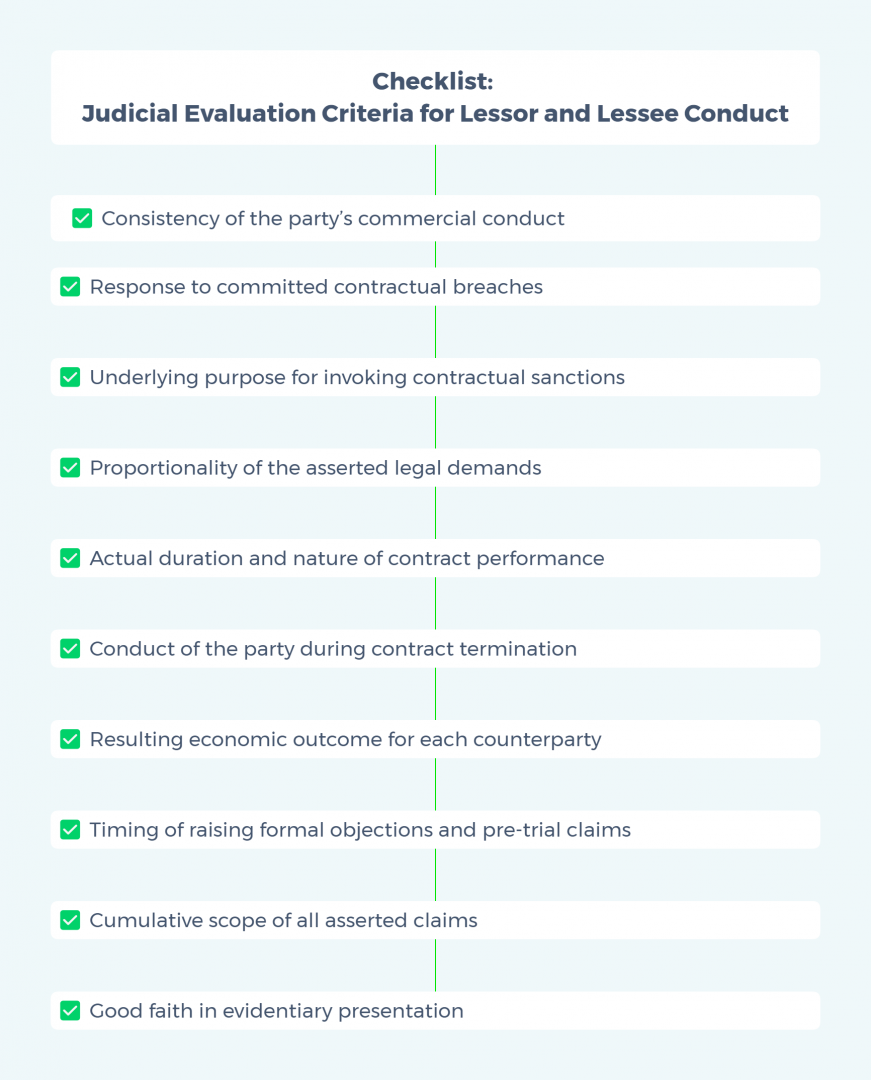
To prevent abusive litigation tactics, judges apply strict good-faith benchmarks to both counterparties:
- whether reasonable attempts were made to restructure arrears or resolve the default prior to initiating termination;
- whether contractual penalties were utilized to incentivize performance rather than extract windfall profits;
- whether the financial remedies demanded correspond to actual economic losses caused by the default;
- whether the lessee raised timely objections regarding equipment defects prior to defaulting on payment schedules.
Grounds and Thresholds for Lease Contract Termination
A technical breach of a leasing contract does not automatically justify termination. Courts treat rescission as a measure of last resort, permissible only when cumulative circumstances demonstrate that further performance is impossible or that the aggrieved party has lost the core economic benefit anticipated at contract execution.
Termination Initiated by the Lessee
Because the lessee assumes primary operational risks upon accepting the equipment, courts scrutinize lessee-initiated termination claims rigorously. Common grounds include delayed asset delivery, latent manufacturing defects, or objective impossibility of using the property for its designated commercial purpose. Judges examine whether the lessee formally demanded defect remediation from the supplier or lessor before falling into payment arrears. Prolonged commercial use of the equipment without documented complaints typically invalidates subsequent attempts to rescind the agreement retroactively.
Termination Initiated by the Lessor
Lessor-initiated termination most frequently stems from payment schedule defaults. However, judicial practice distinguishes between isolated, short-term delays and systematic, substantial arrears. Even when a contract grants the lessor an explicit right of unilateral out-of-court repudiation, arbitration courts verify strict compliance with notice procedures, the provision of a reasonable cure period, and the overall proportionality of terminating a long-term capital arrangement.
|
Termination Ground |
Initiating Party |
Judicial Assessment Criteria |
Typical Court Ruling |
|
systematic payment arrears |
lessor |
duration of delay, frequency of defaults, ratio of debt to total contract price |
termination upheld if default is material and unexcused |
|
isolated or brief payment delay |
lessor |
overall track record of performance and good-faith remediation efforts |
termination generally denied as disproportionate |
|
delayed equipment delivery |
lessee |
loss of commercial interest and whether actual asset operation commenced |
upheld only if commercial utility was lost prior to handover |
|
latent equipment defects |
lessee |
severity, remediability, and timely claims against the equipment supplier |
upheld only if defects render commercial operation impossible |
|
procedural notice violations |
either party |
adherence to contractual delivery rules and mandatory cure periods |
termination invalidated due to procedural non-compliance |
|
abusive unilateral repudiation |
either party |
economic intent behind termination and cumulative remedies sought |
judicial denial of protection under abuse-of-right doctrines |
Asset Repossession Mechanics and Risk Management
Upon valid termination of a lease agreement, the lessee's right to possess and operate the equipment ceases immediately, triggering an obligation to surrender the asset. Courts evaluate the factual circumstances of the handover, distinguishing between voluntary return and forced repossession, as well as separating normal operational wear and tear from actionable property damage.
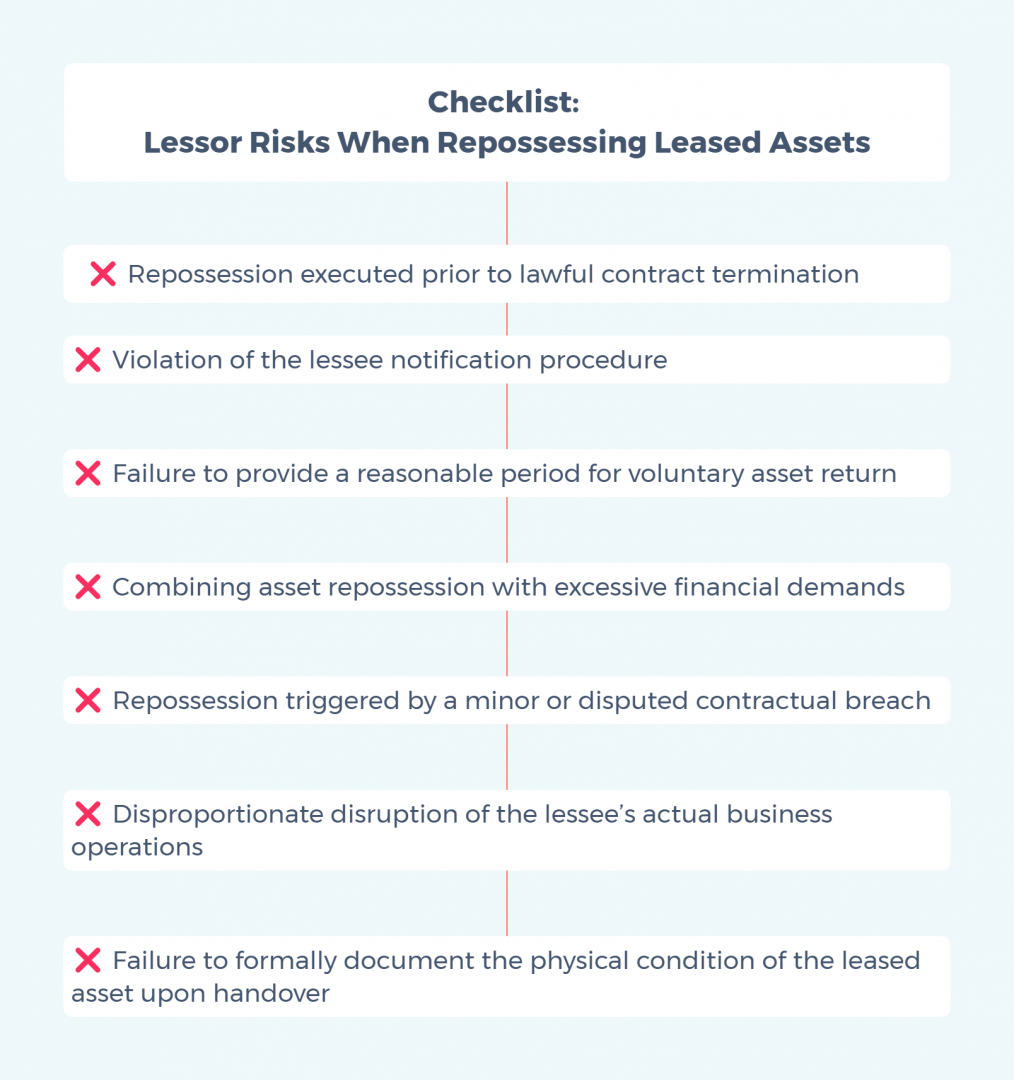
Forced repossession represents the most heavily scrutinized enforcement mechanism available to a lessor. Even where contractual clauses authorize self-help seizure upon default, courts examine whether the lessor provided proper advance notice, granted a reasonable window for voluntary surrender, and avoided disproportionate interference with the lessee's ongoing business operations. Unilateral seizure executed as an instrument of financial pressure—or combined with demands for full accelerated lease payments—routinely results in courts declaring the repossession unlawful and awarding damages to the lessee.
Financial Consequences and Mutual Obligation Netting
Contract termination halts the accrual of future periodic lease payments; billing for periods after valid rescission is consistently rejected by arbitration courts regardless of contrary contractual wording. Instead, termination transitions the relationship into a final financial settlement phase governed by mandatory mutual obligation netting (the net balance method).
Under this doctrine, courts reconcile all reciprocal financial flows to ensure neither party derives an unjustified windfall from early contract termination. The final net balance calculation consolidates:
- total capital financing provided by the lessor to acquire the leased asset, plus agreed financing fees for the actual period of capital usage;
- expenses incurred by the lessor in repossessing, transporting, storing, and remarketing the returned property;
- all advance payments and periodic lease installments previously remitted by the lessee;
- the verified market value of the repossessed asset at the time of return or actual proceeds from its subsequent sale.
If the combined value of the returned equipment and prior payments exceeds the lessor's total capital outlay, accrued financing fees, and validated penalties, the lessor must refund the positive balance to the lessee. Conversely, if a deficit remains, the lessor is entitled to recover the net shortfall. For international lessors and foreign parent entities operating in Russia, post-termination net settlements must also account for applicable currency control regulations, cross-border payment restrictions, and enhanced KYC/AML verification protocols when remitting funds across jurisdictions.
Navigating Legal and Regulatory Risks in Commercial Leasing
Resolving equipment leasing disputes in Russian arbitration courts requires navigating intricate intersections of contract law, insolvency statutes, and evolving judicial doctrines on economic proportionality. Miscalculating post-termination net balances, executing premature asset seizures, or failing to align pre-trial notices with final litigation claims can invalidate enforcement actions and expose enterprises to counterclaims for unjust enrichment or unlawful dispossession. Engaging specialized legal counsel ensures rigorous compliance with procedural prerequisites, defensible financial netting models, and strategic representation throughout negotiations and court proceedings. Our legal team advises international investors, financial institutions, and corporate executives across Russia on structuring cross-border lease transactions, managing distressed asset portfolios, and litigating complex commercial disputes. To assess your contractual exposure and protect your enterprise assets, contact our legal experts through our website or direct consultation channels.
FAQ
How do bankruptcy proceedings affect an active commercial lease agreement?
Can a lessee terminate a lease agreement due to manufacturing defects in the equipment?
What legal risks arise if a lessor repossesses equipment without following contractual notice rules?
How is the value of repossessed equipment determined during post-termination financial netting?
Does a single missed lease payment justify unilateral contract termination by the lessor?
Can a lessor simultaneously repossess leased equipment and collect all remaining future lease payments?

Key Terms
A
Arbitrazh Court (Arbitration Court)
B
Bankruptcy (Insolvency)
C
Compensation for Damages / Recovery of Losses
C
Conflict-of-Laws Rule (Choice-of-Law Rule)
C
Contractual Penalty
J
Judicial Decree / Judicial Resolution (Postanovleniye)
L
Lawsuit / Claim
M
Market Value of the Valued Object
R
Recovery / Debt Collection
Related articles
All articles

Enforcing Foreign Arbitral Awards in Russia in 2026: Key Precedents and Risk Strategy
Enforcing foreign arbitral awards in Russia in 2026 requires navigating strict public-policy scrutiny, anti-suit and sanctions-jurisdiction rules under Russian commercial procedural law—where court enforcement proceedings commonly run several months and award applications are generally subject to a three-year limitation window—alongside practical payment and evidentiary hurdles. Awards rendered by institutions such as the International Chamber of Commerce, the London Court of International Arbitration, the Stockholm Chamber of Commerce, the Singapore International Arbitration Centre, or the Hong Kong International Arbitration Centre face sharply different outcomes depending on jurisdiction, sanctions exposure, due process, and damages mechanics. This guide examines recent judicial precedents, compares arbitral jurisdictions by refusal risk, outlines practical contract and litigation steps, and answers core enforcement questions.

How Foreign Companies Without a Russian Registration Can Enforce Rights in Russian Courts
Foreign companies without a branch, representative office, or local tax registration in Russia can bring claims in Russian state commercial arbitration courts—where cases typically take three to six months compared to nine to 18 months in international commercial arbitration—and may seek interim asset freezes before or alongside a lawsuit. Under Russian commercial procedural law and supreme court practice, foreign entities hold equal procedural standing regardless of jurisdiction, enabling debt recovery, intellectual property enforcement, customs disputes, and claims against digital platforms across domestic and cross-border transactions. This guide outlines core procedural documents, compares dispute forums, examines typical claim scenarios and court outcomes, and answers key litigation questions.

Appealing Commercial Leasing Court Judgments: Appellate, Cassation, and Supervisory Review
Challenging a commercial court judgment in a leasing dispute requires determining the exact procedural stage where an error occurred, distinguishing between factual and legal misapplications, strictly observing statutory deadlines, and aligning appellate argumentation with binding Supreme Court precedents. Under current 2026 arbitration and civil procedural frameworks in Russia, post-judgment review is governed by a strict tiered model where each successive instance narrows the scope of judicial review. For international lessors, corporate executives, and legal counsel managing cross-border commercial assets, mastering appellate and cassation mechanics is vital to overturning flawed financial calculations, reversing unlawful asset repossessions, and safeguarding enterprise liquidity.
Related services
Все услуги
Intellectual Property Law
Civil Law
Procedural Law
Court Representation
Legal support
Russia
Judicial compensation is recovered for the use of copyright, patent, and neighboring rights objects without permission. The amount is determined as a multiple of value or within the range of 10 thousand to 5 million rubles.
Recovery of Compensation for Infringement of Exclusive Rights
Intellectual Property Law
Civil Law
Procedural Law
Legal support
Court Representation
Russia
If a trademark is not used for more than three years, its registration can be early terminated through court. Such a measure makes it possible to eliminate a legal obstacle to registering one's own designation or launching a brand on the market.
Cancellation of Another Party's Trademark for Non-Use
Court Representation
Civil Law
Intellectual Property Law
Disputes with government authorities
Legal support
Rospatent may refuse trademark registration on various grounds, including formal and contentious ones. The law grants the applicant the right to appeal the refusal — both in the Chamber for Patent Disputes (CPD) and through judicial proceedings. Challenging allows for the restoration of the brand's legal protection and the exercise of the exclusive right to the mark.
Challenging a Trademark Registration Refusal
Contact us
Leave a request and our lawyers will contact you as soon as possible to provide a free consultation on your issue.
